


The information century rewards the certified. ExamTorrent helps you join them with 75 practice questions for the Microsoft Designing and Implementing Multi-Agent AI Solutions exam, McAfee-secured checkout, and a written refund policy tied to your real exam result — no slogans required.
Microsoft AI-500 Exam Syllabus Topics:
| Section | Weight | Objectives |
|---|---|---|
| Topic 1: Secure, govern, and deploy multi-agent solutions | 20–25% | - Apply security and compliance
|
| Topic 2: Develop multi-agent solutions in Azure | 30–35% | - Manage state and memory
|
| Topic 3: Architect multi-agent solutions | 15–20% | - Design logical architecture for multi-agent systems
|
| Topic 4: Evaluate, optimize, and monitor multi-agent solutions | 20–25% | - Assess performance and reliability
|
FAQ — Microsoft Designing and Implementing Multi-Agent AI Solutions Exam Preparation
Microsoft lists these recommended training resources for the Microsoft Designing and Implementing Multi-Agent AI Solutions exam:
Official training plus consistent self-testing is a proven combination — the 75 practice questions from ExamTorrent handle the second half.
ExamTorrent issues a full refund if you take the Microsoft Designing and Implementing Multi-Agent AI Solutions exam within 60 days of purchase and do not pass. The policy does not apply if the exam is taken within 3 days of purchase, if the exam was never actually taken, or to free materials or expired orders, and the candidate name must match the payer name. Claims require a scan of your enrollment slip and the official Score Report PDF, submitted within 2 days of the exam, and are processed within 7 days. As an alternative, you can exchange for two free exam products of equal value while keeping your original update service. Orders arrive by email within 1 minute — contact support if nothing shows up within 2 hours.
The Microsoft Designing and Implementing Multi-Agent AI Solutions exam presents 50 with 100 minutes to complete them. Practicing under the same clock in the ExamTorrent Desktop Test Engine makes the real pacing feel routine.
Online proctored or in-person at Pearson VUE test centers Registration for the Microsoft Designing and Implementing Multi-Agent AI Solutions exam goes through these official channels:
After booking, the ExamTorrent practice questions reach your inbox within 1 minute — preparation can start the same day.
The official Microsoft Designing and Implementing Multi-Agent AI Solutions outline defines 4 domains. The leading three are Evaluate, optimize, and monitor multi-agent solutions (20–25%), Secure, govern, and deploy multi-agent solutions (20–25%), and Develop multi-agent solutions in Azure (30–35%). See the complete list in the topics section above — the 75 practice questions at ExamTorrent cover every domain.
The AI-500 exam is a Microsoft certification exam built on the Microsoft Designing and Implementing Multi-Agent AI Solutions syllabus shown above. It contributes to these credential paths: Microsoft Certified: Azure AI Apps and Agents Developer Associate. As information technology keeps reshaping how industries operate, certified skills remain one of the most portable proofs of capability in 2026. ExamTorrent prepares you with 75 practice questions in PDF, Desktop Test Engine, and Online Test Engine formats.
Passing the Microsoft Designing and Implementing Multi-Agent AI Solutions exam requires 700 out of 1000, and the registration fee is $165 USD. A retake costs the same amount again — a practical reason to verify your readiness with the ExamTorrent engines before booking.
The full Microsoft Designing and Implementing Multi-Agent AI Solutions preparation set at an affordable, small-profits price: 75 practice questions in three formats — a printable, expert-prepared PDF with instant download; a Desktop Test Engine for Windows that simulates the real exam with two practice modes and works offline; and an Online Test Engine for any browser on Windows, Mac, Android, and iOS with test history and performance review. A free demo is available anytime, updates are free for 365 days, renewal afterward is 50% off, installations are unlimited, and checkout is McAfee-secured with automatic encryption of your personal information.
Must hold Microsoft Certified: Azure AI Apps and Agents Developer Associate (obtained via Exam AI-103) to earn the certification; may take AI-500 before completing the prerequisite, but certification is only awarded after both requirements are met. Policies change over time, so confirm the current rules on the official Microsoft exam page before scheduling.
Microsoft Designing and Implementing Multi-Agent AI Solutions Sample Questions:
You need to recommend a memory retrieval strategy to support the planned changes for claim Approval.
What should you recommend? To answer, drag the appropriate resources to the correct requirements. Each resource may be used once, more than once, or not at all. You may need to drag the split bar between panes or scroll to view content.
NOTE: Each correct selection is worth one point.
Correct Answer:

Explanation:
Prior claims: memory-store-490; Contact preferences: memory-store-490.
Both requirements describe information that should persist across conversations for the same customer:
previous claim information and stable contact preferences. Microsoft Foundry Memory is intended for durable, cross-session facts and summaries that agents can retrieve later, while a knowledge base is for shared reference content rather than user-specific history. The refund-processing and customer-refund tools are operational interfaces, not persistence layers. Using the existing memory store for both categories therefore matches the scenario ' s design objective. In production, the memory search tool should also be scoped to the end user so one customer ' s memory cannot be retrieved for another customer. Microsoft documents scope- based isolation for memory stores and supports a user-derived scope such as `{{$userId}}`. The key distinction is that the same memory store can hold multiple kinds of durable customer memory as long as retrieval is correctly scoped; there is no need to create separate tools or knowledge indexes for these two user- specific memory categories.
Official Microsoft reference: Create and use memory in Foundry Agent Service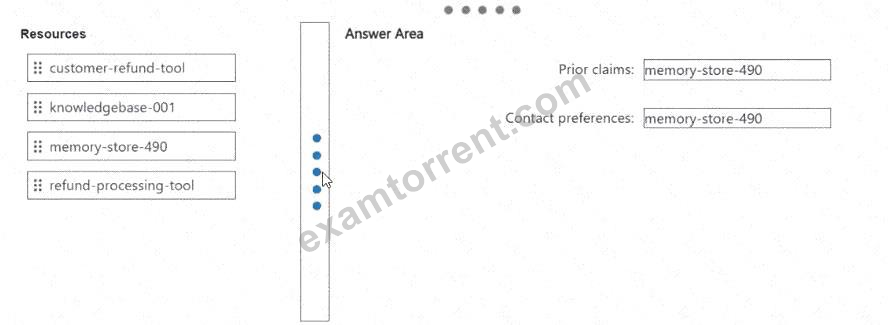
You have a Microsoft Foundry agent built by using LangGraph. The agent retrieves policy content from a vector store. The LangGraph orchestration runs in Azure Container Apps, and the operations team uses Azure Monitor to inspect agent runs.
You discover that the vector store is sometimes unreachable during Azure regional maintenance windows You need to configure the tool ecosystem to ensure that the agent can answer policy questions during outages The solution must meet the following requirements:
* Use the project vector store without adding a local retrieval node for the primary path.
* Run the cached-policy lookup in the same compute environment as the LangGraph code.
* Emit agent, model, and tool spans that can be inspected in Azure Monitor How should you configure the tool ecosystem? To answer, select the appropriate options in the answer area.
NOTE: Each correct selection is worth one point.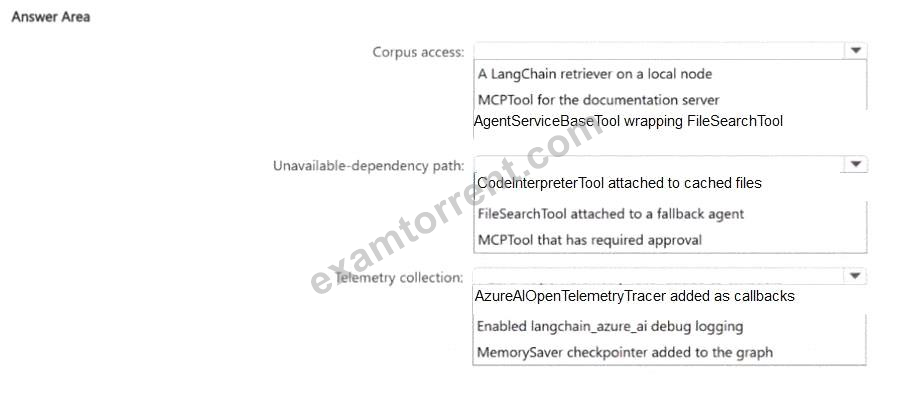
Correct Answer:
Explanation:
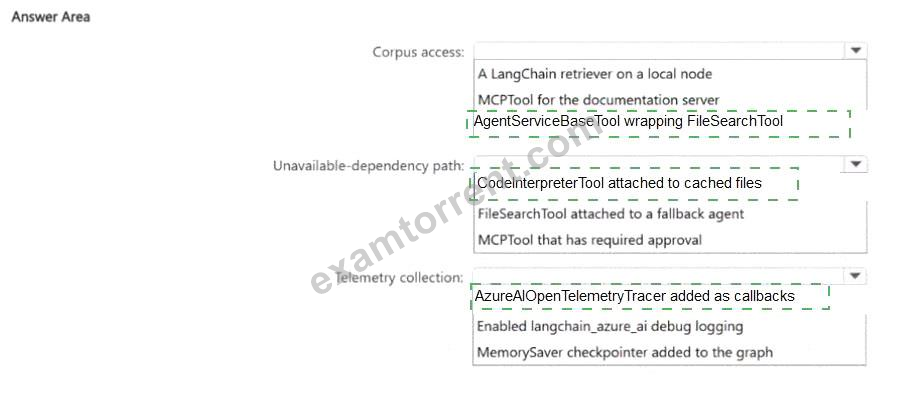
Corpus access: AgentServiceBaseTool wrapping FileSearchTool; Outage fallback: No listed option fully satisfies the requirement to run the cached-policy lookup in the same Azure Container Apps compute; Telemetry: AzureAIOpenTelemetryTracer added as callbacks.
Current Microsoft LangGraph integration guidance supports wrapping Foundry ' s FileSearchTool through AgentServiceBaseTool for the primary project-vector-store path and attaching AzureAIOpenTelemetryTracer through LangGraph callbacks for OpenTelemetry traces. The problematic part is the proposed outage fallback. Code Interpreter is a Foundry-hosted built-in tool, so it does not execute in the same Azure Container Apps compute environment as the LangGraph application. That means a CodeInterpreterTool- based fallback cannot satisfy the explicit same-compute requirement. A technically correct design would use a local LangGraph/LangChain callable or tool over cached policy content mounted or stored with the Container Apps workload. Because that local-tool option is absent from the answer set, there is no fully valid listed selection for the fallback row. The updated answer therefore preserves the two valid selections and explicitly identifies the missing valid option rather than endorsing an inconsistent one. The implementation should also preserve clear inputs and outputs around this step so that later agents receive only the information they require. This improves debuggability and keeps token, permission, and state growth under control as the workflow becomes more complex.
Official Microsoft reference: Microsoft Foundry - develop LangChain/LangGraph agents
You have a Microsoft Foundry multi-agent customer support solution that retrieves grounding data from a shared vector index. The indexed corpus contains product runbooks in Markdown and support articles in HTML Both document types use a consistent hierarchical markup.
You discover that current fixed-size token chunking creates chunks that cross section boundaries.
You need to recommend a chunking approach for the ingestion pipeline. The solution must preserve existing document structure boundaries and minimize custom chunking code.
What should you recommend?
- A. format-specific chunking with header splitters
- B. semantic chunking with topic-shift detection
- C. fixed-size chunking with token overlap
- D. recursive character chunking with structure-aware separators
Correct Answer: A 🗳️
Explanation: Only visible for ExamTorrent members. You can sign-up / login (it's free).
You have the following tool integration configuration for a Microsoft Foundry claims-processing assistant.
For each of the following statements, select Yes if the statement is true. Otherwise, select No.
NOTE: Each correct selection is worth one point.
Correct Answer:

Explanation:
Yes / Yes / No
The first statement is true because the tool-integration contract returns only the explicitly defined `final_text` from FraudReview to ClaimsPlanner; the planner does not automatically receive the specialist ' s entire internal execution history. The second statement is also true because an external REST service such as PremiumRates can be exposed as an OpenAPI-defined tool. The OpenAPI schema describes operations and parameters, while the surrounding agent system retains conversational state; the REST tool itself does not need a developer-managed chat transcript. The third statement is false under the shown configuration because the partner publishes tool descriptors as published while the planner defines which schemas it accepts or rejects. Compatibility handling therefore occurs at the consumer/tool boundary rather than requiring PartnerIntegrations to rewrite every unsupported schema before invocation. The correct sequence is Yes, Yes, No. At implementation time, the same rule should be expressed through the framework or service configuration rather than left only as a natural-language convention. That makes the behavior repeatable across runs, easier to test, and less sensitive to model variability.
Official Microsoft reference: Microsoft Foundry agents - OpenAPI tools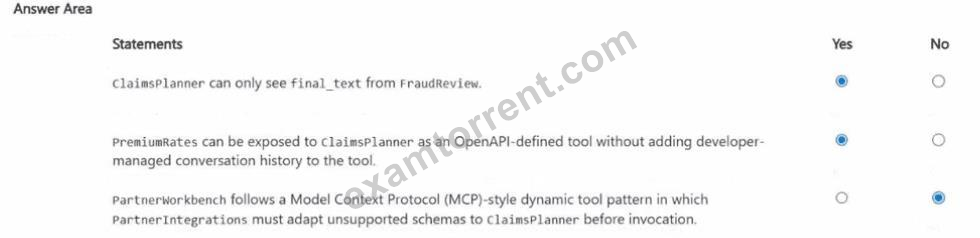
You have a Microsoft Agent Framework workflow. The workflow includes three specialized agents that wrap custom Hugging Face Transformers pipelines for Personally Identifiable Information (P(l) detection, sentiment classification, and summarization Each ticket must be processed by the Pll detection agent first. The sentiment classification agent must receive the redacted ticket text. The summarization agent must receive both the redacted text and the sentiment result You need to coordinate the agents to meet the dependencies.
Which orchestration pattern should you use?
- A. concurrent
- B. handoff
- C. sequential
- D. group chat
Correct Answer: C 🗳️
Explanation: Only visible for ExamTorrent members. You can sign-up / login (it's free).
Viewing page 1 out of 15 pages.
Viewing questions 1-5 out of 75 questions.


 9 Customer Reviews


