

C-C4H450-04 Exam Info and Free Practice Test Professional Quiz Study Materials
Accurate Hot Selling C-C4H450-04 Exam Dumps 2023 Newly Released
SAP C-C4H450-04 Exam Description:
The “SAP Certified Integration Associate – SAP Cloud for Customer” certification exam verifies that the candidate possesses fundamental knowledge to be able to integrate SAP Sales and SAP Service Cloud with SAP S/4HANA, SAP ERP or SAP CRM using SAP Cloud Platform Integration. This certificate proves that the candidate has fundamental understanding within the Integration Consultant profile and is able to apply the associated prerequisite skills practically under supervision of an expert consultant in a project environment.
SAP C-C4H450-04 Exam Syllabus Topics:
| Topic | Details |
|---|---|
| Topic 1 |
|
| Topic 2 |
|
| Topic 3 |
|
| Topic 4 |
|
| Topic 5 |
|
NEW QUESTION 36
What best describes tracing capabilities in SAP Cloud Platform Integration?
- A. Tracing is only available for specific integration flows, because the developer needs to make use of the tracing interface.
- B. After you activate tracing for an integration flow in the Monitor view, it will only stay active for a certain time.
- C. Tracing allows you to analyze the runtime behavior of an integration flow in real time, including script debugging with breakpoints.
- D. You can activate tracing for multiple integration flows at the same time by using the mass configure action in the Design view.
Answer: B
NEW QUESTION 37
When do you need to scope "Integration of Master Data" in SAP Cloud for Customer? Note: There are 3 correct Answers to this question.
- A. When you need to integrate products
- B. When you need to integrate organizational structures
- C. When you need to integrate sales pricing
- D. When you need to integrate campaigns
- E. When you need to integrate employees
Answer: A,B,E
NEW QUESTION 38
Where do you have to import the SAP Cloud Platform Integration root and intermediate CAs when replicating data from SAP S/4HANA to SAP Cloud for Customer?
- A. SAP S/4HANA SSL client PSE
- B. SAP Web Dispatcher trust store
- C. SAP S/4HANA SSL server PSE
- D. SAP Cloud for Customer certificate trust list
Answer: A
NEW QUESTION 39
Where can you verify My System ID (which serves as tenant ID) in the SAP Cloud for Customer configuration?
- A. Communication Arrangements
- B. Communication Systems
- C. Business Configuration
- D. Service Control Center
Answer: D
NEW QUESTION 40
When do you import an updated WSDL into SAP Cloud Platform Integration?
- A. When using a synchronous Web service
- B. When using a reduced IDoc, for example, MATMAS_CFS
- C. When fields required for the integration scenario have been added to the service.
- D. When the initial deploy fails and a new version of the WSDL needs to be exported
Answer: C
NEW QUESTION 41
When does SAP recommend integrating SAP Cloud for Customer with SAP CRM? Note: There are 2 correct Answers to this question.
- A. When the customer wants to leverage the on-premise business processes with innovations in SAP Cloud for Customer
- B. When the business processes provided in SAP Cloud for Customer are duplicates of the business processes used in SAP CRM
- C. When the end user must switch between SAP Cloud for Customer and SAP CRM in one object
- D. When SAP Cloud for Customer acts as a mobile layer on top of SAP CRM
Answer: A
NEW QUESTION 42
You added a new field named "ENVIRONMENT_RISK" in the product business object in SAP Cloud for Customer. You want to populate the new field "ENVIRONMENT_RISK" in SAP Cloud for Customer with the value of the standard field "EnvironmentRelevanceIndicator" in SAP S/4HANA. How would you extend the message mapping in SAP Cloud Platform Integration to perform this task?
- A. Export the WSDL from SAP S/4HANA. Import the WSDL into the communication arrangement in SAP Cloud for Customer. Update the mapping with the new WSDL from SAP Cloud for Customer.
- B. Create an "ENVIRONMENT_RISK" variable in externalized parameters in SAP Cloud Platform Integration. Update the externalized parameters with the variable for the "ENVIRONMENT_RISK" field.
Save and activate the updated externalized parameters. - C. Download the extended WSDL from SAP Cloud for Customer. Import the WSDL into SAP Cloud Platform Integration. Map the "ENVIRONMENT_RISK" target field with source field
"EnvironmentRelevanceIndicator" in the message mapping. - D. Add the "ENVIRONMENT_RISK" field to the target message WSDL in SAP Cloud Platform Integration.
Map the "ENVIRONMENT_RISK" target field with source field "EnvironmentRelevanceIndicator" in the message mapping. Activate the new mapping.
Answer: A
NEW QUESTION 43
How are number ranges configured when you create a contact in SAP Cloud for Customer and replicate it to SAP ERP? Note: There are 2 correct Answers to this question.
- A. An automatic number range is created in SAP Cloud for Customer.
- B. An external number range is created in the value mapping in the middleware.
- C. An external number range is created in SAP Cloud for Customer.
- D. An external number range is created in SAP ERP.
Answer: A,D
NEW QUESTION 44
Which steps are mandatory during the setup of the data replication framework? Note: There are 3 correct Answers to this question.
- A. Define Service Group
- B. Define Data Replication Model
- C. Define Business System
- D. Define Logical System
- E. Define Communication User
Answer: B,C,D
NEW QUESTION 45
How can you determine if a field in the message mapping in SAP Cloud Platform Integration is an extension field?
- A. By the WSDL naming convention
- B. By the mapping functions
- C. By the used namespace
- D. By the mapping icon
Answer: B
NEW QUESTION 46
Where do you find the SAP Cloud Platform Integration client certificate?
- A. In the keystore artifact
- B. In the OAuth2 authentication artifact
- C. In the PGP secret keyring artifact
- D. In the basic authentication artifact
Answer: A
NEW QUESTION 47
What configuration is required before you can send attachments from SAP CRM to SAP Cloud for Customer?
- A. Configure the ATTACHMENTFOLDERREPLICATIONREQ service definition in transaction WE20.
- B. Configure the CO_CRMPCD_ATTACHMENT_FOLDER_RE message type in transaction WE20.
- C. Configure the CO_CRMPCD_ATTACHMENT_FOLDER_RE consumer proxy in SOAMANAGER.
- D. Configure the ATTACHMENTFOLDERREPLICATIONREQ service definition in SOAMANAGER.
Answer: C
NEW QUESTION 48
The following screenshot is an IDoc error from SAP ERP. What does the error message shown in the screenshot indicate?
- A. The error indicates that the SAP Cloud for Customer server certificate has expired.
- B. The error indicates invalid authentication when the message is received in SAP Cloud for Customer.
- C. The error indicates missing authorization when the message is received in SAP Cloud Platform Integration.
- D. The error indicates that the SAP Cloud Platform Integration client certificate has expired.
Answer: B
NEW QUESTION 49
While monitoring messages in SAP Cloud Platform Integration, you see the following error:
[NoArtifactDecriptorFoundForArtifactName]:No artifact descriptor found for artifactName C4C_0M1R00R_TR16. What could be the problem? Note: There are 2 correct Answers to this question.
- A. The SAP Cloud Platform Integration certificate has expired.
- B. The authentication artifact name was spelled incorrectly in the integration flow configuration.
- C. The basic authentication artifact was not deployed
- D. The client certificate uploaded into the integration flow has no credentials.
Answer: B,C
NEW QUESTION 50
The following screenshot is an IDoc error from SAP ERP. What does the error message shown in the screenshot indicate?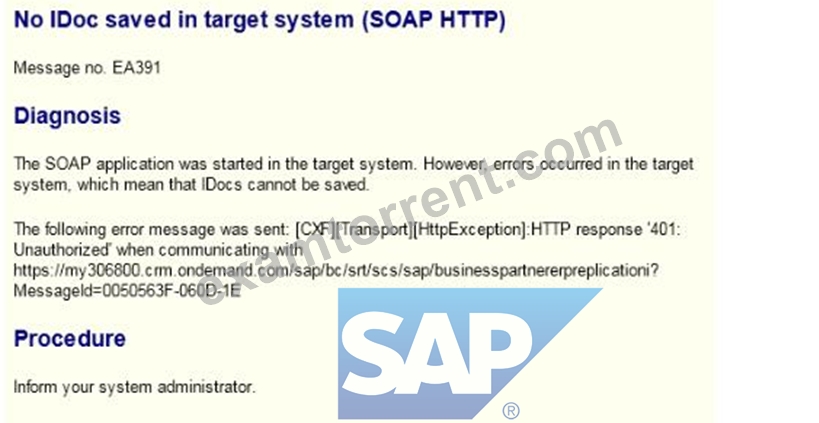
- A. The error indicates that the SAP Cloud Platform Integration client certificate has expired.
- B. The error indicates that the SAP Cloud for Customer server certificate has expired.
- C. The error indicates missing authorization when the message is received in SAP Cloud Platform Integration.
- D. The error indicates invalid authentication when the message is received in SAP Cloud for Customer.
Answer: A
NEW QUESTION 51
You want to integrate SAP Cloud for Customer with SAP ERP using SAP Cloud Platform Integration. What information should you provide in the path field in the outbound communication arrangement?
- A. The path of the SAP ERP IDoc service
- B. The path of the communication system
- C. The path of the reverse proxy
- D. The path of the deployed integration flow
Answer: D
NEW QUESTION 52
What security method is mandatory in the architecture between SAP Cloud for Customer and SAP Cloud Platform Integration?
- A. Client certificate authentication
- B. Reverse proxy
- C. Forward proxy
- D. HTTPS communication
Answer: A
NEW QUESTION 53
Which service group configuration steps in SAP S/4HANA will be used for all services if the same middleware is used? Note: There are 2 correct Answers to this question.
- A. WSDLs
- B. Logon data management
- C. Profile
- D. Provider system
Answer: B,C
NEW QUESTION 54
......
Get 100% Authentic SAP C-C4H450-04 Dumps with Correct Answers: https://pass4sure.examtorrent.com/C-C4H450-04-prep4sure-dumps.html
