

Dumps Moneyack Guarantee - HPE6-A78 Dumps UpTo 50% Off
Updated Jun-2025 Pass HPE6-A78 Exam - Real Practice Test Questions
NEW QUESTION # 93
Your HPE Aruba Networking Mobility Master-based solution has detected a rogue AP. Among other information, the AOS Detected Radios page lists this information for the AP:
SSID = PublicWiFi
BSSID = a8:bd:27:12:34:56
Match method = Plus one
Match method = Eth-Wired-Mac-Table
The security team asks you to explain why this AP is classified as a rogue. What should you explain?
- A. The AP is probably connected to your LAN because it has a BSSID that is close to a MAC address that has been detected in your LAN. Because it does not belong to the company, it is a suspected rogue.
- B. The AP is an AP that belongs to your solution. However, the AOS has detected that it is behaving suspiciously. It might have been compromised, so it is classified as a suspected rogue.
- C. The AP has a BSSID that is close to your authorized APs' BSSIDs. This indicates that the AP might be spoofing the corporate SSID and attempting to lure clients to it, making the AP a suspected rogue.
- D. The AP has been detected using multiple MAC addresses. This indicates that the AP is spoofing its MAC address, which qualifies it as a suspected rogue.
Answer: A
Explanation:
HPE Aruba Networking's Wireless Intrusion Prevention (WIP) system, part of the AOS-8 architecture (Mobility Master and Mobility Controllers), is designed to detect and classify rogue APs. The "AOS Detected Radios" page provides details about detected APs, including their SSID, BSSID, and match methods used to classify them.
In this case, the AP is classified as a rogue with the following match methods:
Plus one: This indicates that the BSSID of the detected AP is numerically close (e.g., differs by one in the last octet) to the MAC address of a known device in the network.
Eth-Wired-Mac-Table: This indicates that the AP's MAC address (or a closely related MAC address) was found in the wired network's MAC address table, suggesting that the AP is connected to the LAN.
These match methods suggest that the AP is likely connected to the company's wired LAN (via the Eth-Wired-Mac-Table match) and has a BSSID that is close to a known device's MAC address (Plus one match). Since this AP is not part of the company's authorized AP list (it's broadcasting "PublicWiFi," which may not be a corporate SSID), it is classified as a suspected rogue. This scenario is common when an unauthorized AP is plugged into the corporate LAN, posing a security risk.
Option A, "The AP has been detected using multiple MAC addresses," is incorrect because the match methods do not indicate multiple MAC addresses; they indicate a close match to a known MAC and a presence in the wired MAC table.
Option C, "The AP is an AP that belongs to your solution," is incorrect because the AP is classified as a rogue, meaning it is not part of the authorized APs in the solution.
Option D, "The AP has a BSSID that is close to your authorized APs' BSSIDs," is partially correct in that the "Plus one" match indicates a close BSSID, but the key reason for the rogue classification is its connection to the LAN (Eth-Wired-Mac-Table), not just the BSSID similarity.
The HPE Aruba Networking AOS-8 8.11 User Guide states:
"The Wireless Intrusion Prevention (WIP) system detects rogue APs by analyzing their BSSIDs, SSIDs, and connectivity to the wired network. The 'Eth-Wired-Mac-Table' match method indicates that the AP's MAC address (or a closely related address) was found in the wired network's MAC address table, suggesting that the AP is connected to the LAN. The 'Plus one' match method indicates that the AP's BSSID is numerically close to a known MAC address in the network, which can indicate a potential rogue device attempting to mimic a legitimate device." (Page 412, Rogue AP Detection Section) Additionally, the guide notes:
"A rogue AP is classified as 'suspected rogue' if it is detected on the wired network (e.g., via Eth-Wired-Mac-Table) and is not part of the authorized AP list. This often occurs when an unauthorized AP is connected to the corporate LAN." (Page 413, Rogue AP Classification Section)
:
HPE Aruba Networking AOS-8 8.11 User Guide, Rogue AP Detection Section, Page 412.
HPE Aruba Networking AOS-8 8.11 User Guide, Rogue AP Classification Section, Page 413.
NEW QUESTION # 94
Refer to the exhibit.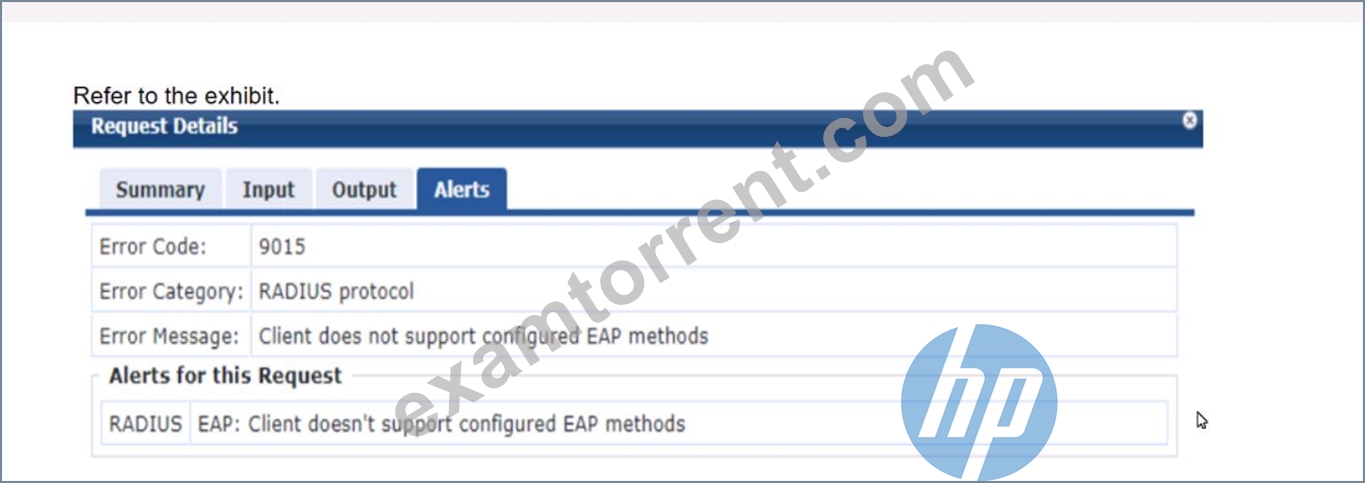
A company has an Aruba Instant AP cluster. A Windows 10 client is attempting to connect a WLAN that enforces WPA3-Enterprise with authentication to ClearPass Policy Manager (CPPM). CPPM is configured to require EAP-TLS. The client authentication fails. In the record for this client's authentication attempt on CPPM, you see this alert.
What is one thing that you check to resolve this issue?
- A. whether the client has a third-party 802.1 X supplicant, as Windows 10 does not support EAP-TLS
- B. whether the client has a valid certificate installed on it to let it support EAP-TLS
- C. whether EAP-TLS is enabled in the SSID Profile settings for the WLAN on the IAP cluster
- D. whether EAP-TLS is enabled in the AAA Profile settings for the WLAN on the IAP cluster
Answer: B
Explanation:
In the context of WPA3-Enterprise with EAP-TLS authentication, the error message "Client doesn't support configured EAP methods" suggests that the client is not able to complete the EAP-TLS authentication process. EAP-TLS requires that both the server (in this case, CPPM) and the client have a valid certificate for mutual authentication. Windows 10 does support EAP-TLS natively, so options A, C, and D can be ruled out.
The most likely reason for the authentication failure is that the client device does not have the correct client certificate installed, which is required to establish a TLS session with the server. Therefore, ensuring that the client has a valid certificate installed that matches the server's requirements is the correct step to resolve this issue.
NEW QUESTION # 95
Which endpoint classification capabilities do Aruba network infrastructure devices have on their own without ClearPass solutions?
- A. ArubaOS devices can use a combination of DHCP fingerprints, HTTP User-Agent strings, and Nmap to construct endpoint profiles.
- B. ArubaOS-Switches can use DHCP fingerprints to construct detailed endpoint profiles.
- C. ArubaOS-CX switches can use a combination of active and passive methods to assign roles to clients.
- D. ArubaOS devices (controllers and lAPs) can use DHCP fingerprints to assign roles to clients.
Answer: D
Explanation:
Without the integration of Aruba ClearPass or other advanced network access control solutions, ArubaOS devices (controllers and Instant APs) are able to use DHCP fingerprinting to assign roles to clients. This method allows the devices to identify the type of client devices connecting to the network based on the DHCP requests they send. While this is a more basic form of endpoint classification compared to the capabilities provided by ClearPass, it still enables some level of access control based on device type. This functionality and its limitations are described in Aruba's product documentation for ArubaOS devices, highlighting the benefits of integrating a full-featured solution like ClearPass for more granular and powerful endpoint classification capabilities.
NEW QUESTION # 96
What is a use case for Transport Layer Security (TLS)?
- A. to enable a client and a server to establish secure communications for another protocol
- B. to enable two parties to asymmetrically encrypt and authenticate all data that passes be-tween them
- C. to provide a secure alternative to certificate authentication that is easier to implement
- D. to establish a framework for devices to determine when to trust other devices' certificates
Answer: A
Explanation:
The use case for Transport Layer Security (TLS) is to enable a client and a server to establish secure communications for another protocol. TLS is a cryptographic protocol designed to provide secure communication over a computer network. It is widely used for web browsers and other applications that require data to be securely exchanged over a network, such as file transfers, VPN connections, and voice-over-IP (VoIP). TLS operates between the transport layer and the application layer of the Internet Protocol Suite and is used to secure various other protocols like HTTP (resulting in HTTPS), SMTP, IMAP, and more. This protocol ensures privacy and data integrity between two communicating applications.
Detailed information about TLS and its use cases can be found in IETF RFC 5246, which outlines the specifications for TLS 1.2, and in subsequent RFCs that define TLS 1.3.
NEW QUESTION # 97
What is a Key feature of me ArubaOS firewall?
- A. The firewall is stateful which means that n can track client sessions and automatically allow return traffic for permitted sessions
- B. The firewall is designed to fitter traffic primarily based on wireless 802.11 headers, making it ideal for mobility environments
- C. The firewall Includes application layer gateways (ALGs). which it uses to filter Web traffic based on the reputation of the destination web site.
- D. The firewall examines all traffic at Layer 2 through Layer 4 and uses source IP addresses as the primary way to determine how to control traffic.
Answer: C
NEW QUESTION # 98
You have deployed a new Aruba Mobility Controller (MC) and campus APs (CAPs). One of the WLANs enforces 802.IX authentication lo Aruba ClearPass Policy Manager {CPPM) When you test connecting the client to the WLAN. the test falls You check Aruba ClearPass Access Tracker and cannot find a record of the authentication attempt You ping from the MC to CPPM. and the ping is successful.
What is a good next step for troubleshooting?
- A. Renew CPPM's RADIUS/EAP certificate
- B. Check CPPM Event viewer.
- C. Check connectivity between CPPM and a backend directory server
- D. Reset the user credentials
Answer: B
NEW QUESTION # 99
What are the roles of 802.1X authenticators and authentication servers?
- A. The authenticator supports only EAP, while the authentication server supports only RADIUS.
- B. The authenticator is a RADIUS client and the authentication server is a RADIUS server.
- C. The authenticator stores the user account database, while the server stores access policies.
- D. The authenticator makes access decisions and the server communicates them to the supplicant.
Answer: B
Explanation:
In the 802.1X network access control model, the roles of the authenticator and the authentication server are distinct yet complementary. The authenticator acts as a RADIUS client, which is a network device, like a switch or wireless access point, that directly interfaces with the client machine (supplicant). The authentication server, typically a RADIUS server, is responsible for verifying the credentials provided by the supplicant through the authenticator. This setup helps in separating the duties where the authenticator enforces authentication but does not decide on the validity of the credentials, which is the role of the authentication server.
:
IEEE 802.1X standard for network access control.
NEW QUESTION # 100
Refer to the exhibit.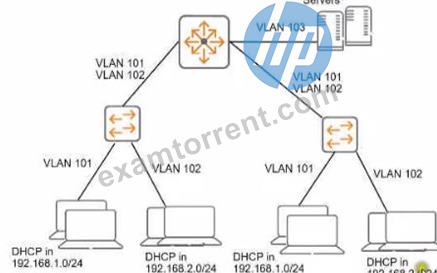
You need to ensure that only management stations in subnet 192.168.1.0/24 can access the ArubaOS-Switches' CLI. Web Ul. and REST interfaces The company also wants to let managers use these stations to access other parts of the network What should you do?
- A. Specify 192.168.1.0.255.255.255.0 as authorized IP manager address
- B. Specify vlan 100 as the management vlan for the switches.
- C. Configure the switch to listen for these protocols on OOBM only.
- D. Establish a Control Plane Policing class that selects traffic from 192.168 1.0/24.
Answer: A
Explanation:
To ensure that only management stations in the subnet 192.168.1.0/24 can access the ArubaOS-Switches' Command Line Interface (CLI), Web UI, and REST interfaces, while also allowing managers to access other parts of the network, you should specify 192.168.1.0 255.255.255.0 as the authorized manager IP address on the switches. This configuration will restrict access to the switch management interfaces to devices within the specified IP address range, effectively creating a management access list.
:
ArubaOS-Switch management and configuration guide detailing IP authorized manager settings.
Network management best practices which recommend controlling access to network devices' management interfaces.
NEW QUESTION # 101
What is a reason to set up a packet capture on an Aruba Mobility Controller (MC)?
- A. The security team believes that a wireless endpoint connected to the MC is launching an attack and wants to examine the traffic more closely.
- B. You want the MC to analyze wireless clients' traffic at a lower level, so that the ArubaOS firewall can control Web traffic based on the destination URL.
- C. The company wants to use ClearPass Policy Manager (CPPM) to profile devices and needs to receive HTTP User-Agent strings from the MC.
- D. You want the MC to analyze wireless clients' traffic at a lower level, so that the ArubaOS firewall can control the traffic I based on application.
Answer: A
Explanation:
Setting up a packet capture on an Aruba Mobility Controller (MC) is particularly useful in scenarios where detailed analysis of network traffic is necessary to identify and address security concerns. Option B is the correct answer because it directly addresses the need to closely examine the traffic of a potentially malicious wireless endpoint. Packet capture on the MC allows the security team to collect and analyze traffic to/from specific endpoints in real-time, providing valuable insights into the nature of the traffic and potentially identifying harmful activities. This capability is essential for forensics and troubleshooting security incidents, enabling administrators to respond effectively to threats.
:
Aruba Mobility Controller Configuration Guide
Aruba Networks Official Documentation
NEW QUESTION # 102
Refer to the exhibit.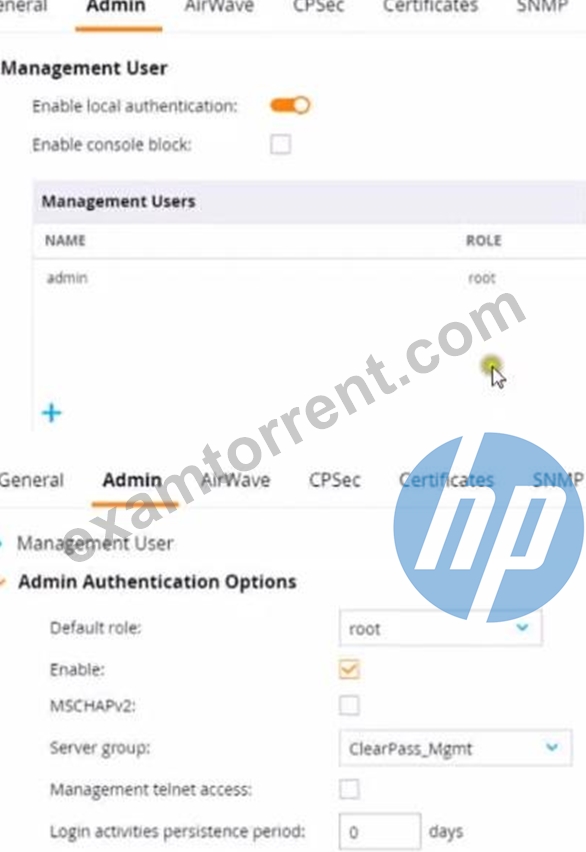
This Aruba Mobility Controller (MC) should authenticate managers who access the Web Ul to ClearPass Policy Manager (CPPM) ClearPass admins have asked you to use RADIUS and explained that the MC should accept managers' roles in Aruba-Admin-Role VSAs Which setting should you change to follow Aruba best security practices?
- A. Disable local authentication
- B. Clear the MSCHAP check box
- C. Change the local user role to read-only
- D. Change the default role to "guest-provisioning"
Answer: D
NEW QUESTION # 103
Refer to the exhibit, which shows the settings on the company's MCs.
You have deployed about 100 new HPE Aruba Networking 335 APs. What is required for the APs to become managed?
- A. Approving the APs as authorized APs on the AP whitelist
- B. Configuring a PAPI key that matches on the APs and MCs
- C. Installing self-signed certificates on the APs
- D. Installing CA-signed certificates on the APs
Answer: A
Explanation:
The scenario involves an AOS-8 Mobility Controller (MC) with Control Plane Security (CPSec) enabled and auto certificate provisioning disabled. CPSec is a feature that secures the control plane communication between the MC and APs using certificates. When CPSec is enabled, APs must be authorized and trusted by the MC to become managed.
CPSec Enabled, Auto Cert Provisioning Disabled: When CPSec is enabled, APs must have a valid certificate to establish a secure control plane connection with the MC. If auto certificate provisioning is disabled (as shown in the exhibit), the MC does not automatically provision certificates to the APs. Instead, the APs must already have a factory-installed certificate (or a manually installed certificate), and the MC must trust the AP's certificate by having the issuing CA in its trust list. Additionally, the AP must be on the MC's AP whitelist to be authorized.
AP Whitelist: The AP whitelist is a list of authorized APs maintained on the MC (or Mobility Master, MM, if present). For an AP to become managed, its MAC address must be in the whitelist, especially when CPSec is enabled and auto provisioning is disabled. This ensures that only authorized APs can connect to the MC.
Option A, "Installing CA-signed certificates on the APs," is incorrect because HPE Aruba Networking APs, such as the 335 series, come with factory-installed certificates signed by Aruba's CA. These certificates are sufficient for CPSec, provided the MC trusts the Aruba CA (which is typically preconfigured). Manually installing CA-signed certificates is not required unless the factory certificates are not used or trusted.
Option B, "Approving the APs as authorized APs on the AP whitelist," is correct. With CPSec enabled and auto cert provisioning disabled, the APs must be explicitly authorized by adding their MAC addresses to the AP whitelist on the MC. This step ensures that the MC accepts the AP's certificate and allows it to become managed.
Option C, "Installing self-signed certificates on the APs," is incorrect because self-signed certificates are not typically used for CPSec. APs use factory-installed certificates, and the MC must trust the issuing CA. Self-signed certificates would require manual trust configuration on the MC, which is not a standard practice.
Option D, "Configuring a PAPI key that matches on the APs and MCs," is incorrect. PAPI (Protocol for AP Provisioning and Information) keys are used for securing communication between APs and the MC in non-CPSec environments or for specific configurations (e.g., when CPSec is disabled). When CPSec is enabled, certificate-based authentication replaces the need for a PAPI key.
The HPE Aruba Networking AOS-8 8.11 User Guide states:
"When Control Plane Security (CPSec) is enabled and auto certificate provisioning is disabled, APs must be authorized by adding their MAC addresses to the AP whitelist on the Mobility Controller (or Mobility Master). The AP uses its factory-installed certificate to establish a secure control plane connection with the MC. The MC must trust the CA that issued the AP's certificate (e.g., Aruba's CA), and the AP must be in the whitelist to become managed. To add an AP to the whitelist, navigate to Configuration > Access Points > AP Whitelist in the MC UI and add the AP's MAC address." (Page 395, CPSec Configuration Section) Additionally, the HPE Aruba Networking CPSec Deployment Guide notes:
"If auto cert provisioning is disabled, the AP whitelist becomes mandatory for CPSec. Each AP must be explicitly approved by adding its MAC address to the whitelist, ensuring that only authorized APs can connect to the MC. The AP's factory certificate is used for authentication, and no manual certificate installation is required on the AP." (Page 12, CPSec with Manual Provisioning Section)
:
HPE Aruba Networking AOS-8 8.11 User Guide, CPSec Configuration Section, Page 395.
HPE Aruba Networking CPSec Deployment Guide, CPSec with Manual Provisioning Section, Page 12.
NEW QUESTION # 104
A company is deploying AOS-CX switches to support 114 employees, which will tunnel client traffic to an HPE Aruba Networking Mobility Controller (MC) for the MC to apply firewall policies and deep packet inspection (DPI). This MC will be dedicated to receiving traffic from the AOS-CX switches.
What are the licensing requirements for the MC?
- A. One PEF license per switch
- B. One AP license per switch, and one PEF license per switch
- C. One AP license per switch
- D. One PEF license per switch, and one WCC license per switch
Answer: A
Explanation:
The scenario involves AOS-CX switches tunneling client traffic to an HPE Aruba Networking Mobility Controller (MC) in an AOS-8 architecture. The MC will apply firewall policies and perform deep packet inspection (DPI) on the tunneled traffic. The MC is dedicated to receiving traffic from the AOS-CX switches, and there are 114 employees (implying 114 potential clients). The question asks about the licensing requirements for the MC.
Tunneling from AOS-CX Switches to MC: In this setup, the AOS-CX switches act as Layer 2 devices, tunneling client traffic to the MC using a mechanism like GRE or VXLAN (though GRE is more common in AOS-8). The MC treats the tunneled traffic as if it were coming from wireless clients, applying firewall policies and DPI.
Licensing in AOS-8:
AP License (Access Point License): Required for each AP managed by the MC. Since the scenario involves AOS-CX switches tunneling traffic, not APs, AP licenses are not required.
PEF License (Policy Enforcement Firewall License): Required to enable the stateful firewall and DPI features on the MC. The PEF license is based on the number of devices (e.g., switches, APs) or users that the MC processes traffic for. In this case, the MC is processing traffic from AOS-CX switches, and the license is typically per switch (not per user or employee).
WCC License (Web Content Classification License): An optional license that enhances DPI by enabling URL-based filtering and web content classification. This is not mentioned as a requirement in the scenario.
Option A, "One PEF license per switch," is correct. Since the MC is dedicated to receiving traffic from the AOS-CX switches, and the MC will apply firewall policies and DPI, a PEF license is required. In AOS-8, when switches tunnel traffic to an MC, the PEF license is typically required per switch (not per user). With 114 employees, the number of switches is not specified, but the licensing model is per switch, so one PEF license per switch is needed.
Option B, "One PEF license per switch, and one WCC license per switch," is incorrect. While a PEF license is required, a WCC license is not mentioned as a requirement. WCC is for advanced web filtering, which is not specified in the scenario.
Option C, "One AP license per switch," is incorrect. AP licenses are for managing APs, not switches. Since the scenario involves switches tunneling traffic, not APs, AP licenses are not required.
Option D, "One AP license per switch, and one PEF license per switch," is incorrect for the same reason as Option C. AP licenses are not needed, but the PEF license per switch is correct.
The HPE Aruba Networking AOS-8 8.11 User Guide states:
"The Policy Enforcement Firewall (PEF) license is required on the Mobility Controller to enable stateful firewall policies and deep packet inspection (DPI). When AOS-CX switches tunnel client traffic to the MC for firewall processing, a PEF license is required for each switch. The license is based on the number of devices (e.g., switches) sending traffic to the MC, not the number of users. For example, if 10 switches tunnel traffic to the MC, 10 PEF licenses are required." (Page 375, Licensing Requirements Section) Additionally, the HPE Aruba Networking Licensing Guide notes:
"PEF licenses on the Mobility Controller are required for firewall and DPI features. In deployments where switches tunnel traffic to the MC, the PEF license is typically per switch. AP licenses are not required unless the MC is managing APs. The Web Content Classification (WCC) license is optional and only needed for advanced URL filtering, which is not required for basic DPI." (Page 15, PEF Licensing Section)
:
HPE Aruba Networking AOS-8 8.11 User Guide, Licensing Requirements Section, Page 375.
HPE Aruba Networking Licensing Guide, PEF Licensing Section, Page 15.
NEW QUESTION # 105
How can hackers implement a man-in-the-middle (MITM) attack against a wireless client?
- A. The hacker runs an NMap scan on the wireless client to find its MAC and IP address. The hacker then connects to another network and spoofs those addresses.
- B. The hacker connects a device to the same wireless network as the client and responds to the client's ARP requests with the hacker device's MAC address.
- C. The hacker uses a combination of software and hardware to jam the RF band and prevent the client from connecting to any wireless networks.
- D. The hacker uses spear-phishing to probe for the IP addresses that the client is attempting to reach. The hacker device then spoofs those IP addresses.
Answer: B
Explanation:
A man-in-the-middle (MITM) attack involves an attacker positioning themselves between a wireless client and the legitimate network to intercept or manipulate traffic. HPE Aruba Networking documentation often discusses MITM attacks in the context of wireless security threats and mitigation strategies.
Option D, "The hacker connects a device to the same wireless network as the client and responds to the client's ARP requests with the hacker device's MAC address," is correct. This describes an ARP poisoning (or ARP spoofing) attack, a common MITM technique in wireless networks. The hacker joins the same wireless network as the client (e.g., by authenticating with the same SSID and credentials). Once on the network, the hacker sends fake ARP responses to the client, associating the hacker's MAC address with the IP address of the default gateway (or another target device). This causes the client to send traffic to the hacker's device instead of the legitimate gateway, allowing the hacker to intercept, modify, or forward the traffic, thus performing an MITM attack.
Option A, "The hacker uses a combination of software and hardware to jam the RF band and prevent the client from connecting to any wireless networks," is incorrect. Jamming the RF band would disrupt all wireless communication, including the hacker's ability to intercept traffic. This is a denial-of-service (DoS) attack, not an MITM attack.
Option B, "The hacker runs an NMap scan on the wireless client to find its MAC and IP address. The hacker then connects to another network and spoofs those addresses," is incorrect. NMap scans are used for network discovery and port scanning, not for implementing an MITM attack. Spoofing MAC and IP addresses on another network does not position the hacker to intercept the client's traffic on the original network.
Option C, "The hacker uses spear-phishing to probe for the IP addresses that the client is attempting to reach. The hacker device then spoofs those IP addresses," is incorrect. Spear-phishing is a delivery method for malware or credentials theft, not a direct method for implementing an MITM attack. Spoofing IP addresses alone does not allow the hacker to intercept traffic unless they are on the same network and can manipulate routing (e.g., via ARP poisoning).
The HPE Aruba Networking AOS-8 8.11 User Guide states:
"A common man-in-the-middle (MITM) attack against wireless clients involves ARP poisoning. The hacker connects a device to the same wireless network as the client and sends fake ARP responses to the client, associating the hacker's MAC address with the IP address of the default gateway. This causes the client to send traffic to the hacker's device, allowing the hacker to intercept and manipulate the traffic." (Page 422, Wireless Threats Section) Additionally, the HPE Aruba Networking Security Guide notes:
"ARP poisoning is a prevalent MITM attack in wireless networks. The attacker joins the same network as the client and responds to the client's ARP requests with the attacker's MAC address, redirecting traffic through the attacker's device. This allows the attacker to intercept sensitive data or modify traffic between the client and the legitimate destination." (Page 72, Wireless MITM Attacks Section)
:
HPE Aruba Networking AOS-8 8.11 User Guide, Wireless Threats Section, Page 422.
HPE Aruba Networking Security Guide, Wireless MITM Attacks Section, Page 72.
NEW QUESTION # 106
You are deploying an Aruba Mobility Controller (MC). What is a best practice for setting up secure management access to the ArubaOS Web UP
- A. Change the default 4343 port tor the web UI to TCP 443.
- B. Make sure to enable HTTPS for the Web UI and select the self-signed certificate Installed in the factory.
- C. Install a CA-signed certificate to use for the Web UI server certificate.
- D. Avoid using external manager authentication tor the Web UI.
Answer: C
NEW QUESTION # 107
A company has Aruba Mobility Controllers (MCs). Aruba campus APs. and ArubaOS-CX switches. The company plans to use ClearPass Policy Manager (CPPM) to classify endpoints by type The ClearPass admins tell you that they want to run Network scans as part of the solution What should you do to configure the infrastructure to support the scans?
- A. Create SNMPv3 users on ArubaOS-CX switches, and make sure that the credentials match those configured on CPPM
- B. Create a TA profile on the ArubaOS-Switches with the root CA certificate for ClearPass's HTTPS certificate
- C. Create device fingerprinting profiles on the ArubaOS-Switches that include SNMP. and apply the profiles to edge ports
- D. Create remote mirrors on the ArubaOS-Swrtches that collect traffic on edge ports, and mirror it to CPPM's IP address.
Answer: A
Explanation:
To configure the infrastructure to support network scans as part of the ClearPass Policy Manager (CPPM) solution, creating SNMPv3 users on ArubaOS-CX switches is necessary. Ensuring that the credentials for these SNMPv3 users match those configured on CPPM is crucial for enabling CPPM to perform network scans effectively. SNMPv3 provides a secure method for network management by offering authentication and encryption, which are essential for safely conducting scans that classify endpoints by type. This configuration allows CPPM to communicate securely with the switches and gather necessary data without compromising network security.
References:
ArubaOS-CX configuration manuals that discuss SNMP settings.
Network management and security guidelines that emphasize the importance of secure SNMP configurations for network scanning and monitoring.
NEW QUESTION # 108
The first exhibit shows roles on the MC, listed in alphabetic order. The second and third exhibits show the configuration for a WLAN to which a client connects. Which description of the role assigned to a user under various circumstances is correct?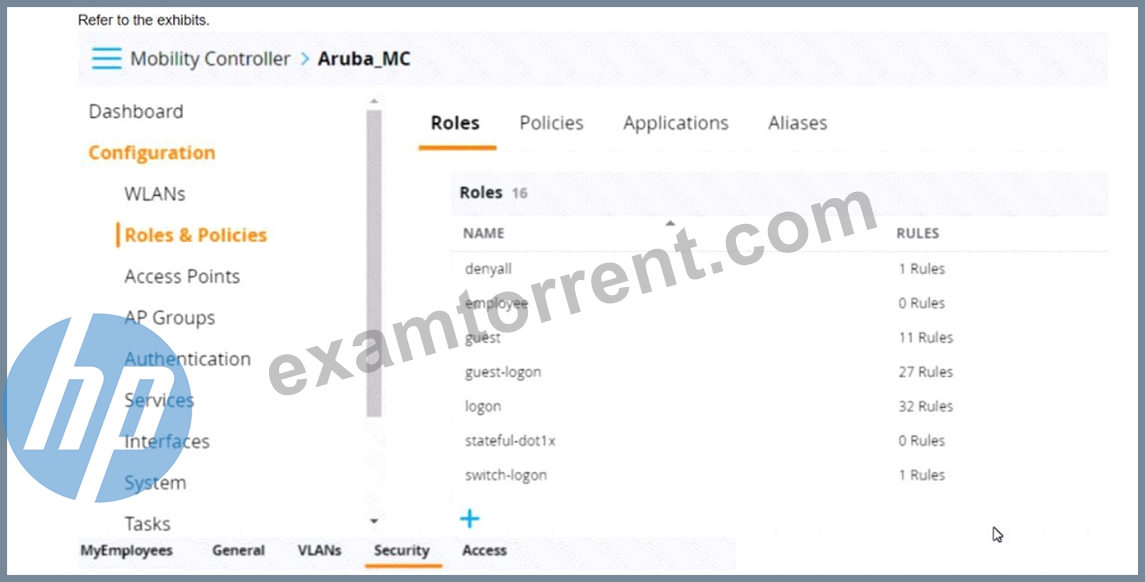
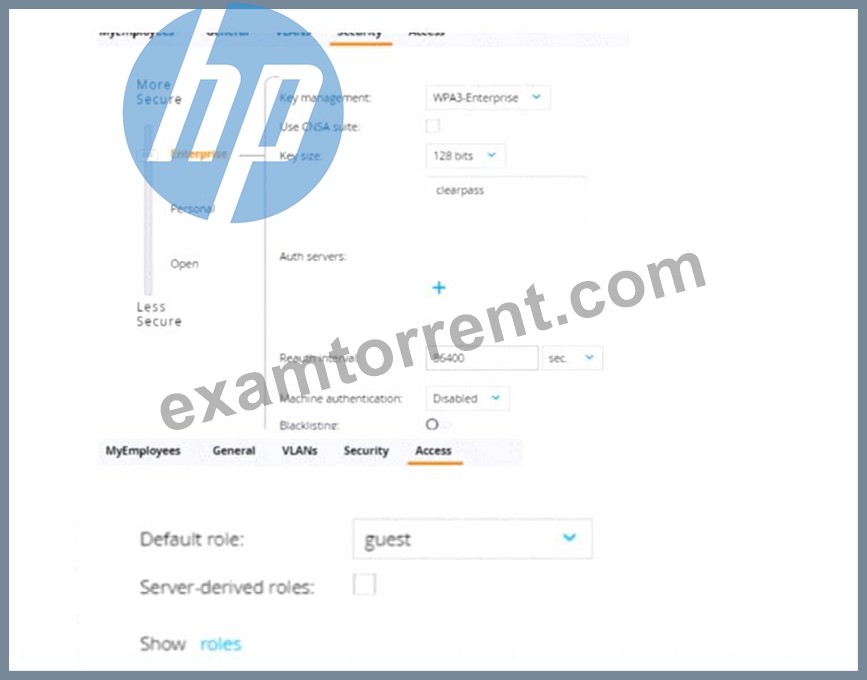
- A. A user authenticates successfully with 802.1X, and the RADIUS Access-Accept includes an Aruba-User-RoleVSA set to "employeel." The client's role is "employeel."
- B. A user authenticates successfully with 802.1X. and the RADIUS Access-Accept includes an Aruba-User-Role VSA set to "employee." The client's role is "guest."
- C. A user fails 802.1X authentication. The client remains connected, but is assigned the "guest" role.
- D. A user authenticates successfully with 802.1 X. and the RADIUS Access-Accept includes an Aruba-User-Role VSA set to "employeel." The client's role is "guest."
Answer: A
Explanation:
In a WLAN setup that uses 802.1X for authentication, the role assigned to a user is determined by the result of the authentication process. When a user successfully authenticates via 802.1X, the RADIUS server may include a Vendor-Specific Attribute (VSA), such as the Aruba-User-Role, in the Access-Accept message.
This attribute specifies the role that should be assigned to the user. If the RADIUS Access-Accept message includes an Aruba-User-Role VSA set to "employee1", the client should be assigned the "employee1" role, as per the VSA, and not the default "guest" role. The "guest" role would typically be a fallback if no other role is specified or if the authentication fails.
NEW QUESTION # 109
Refer to the exhibit, which shows the current network topology.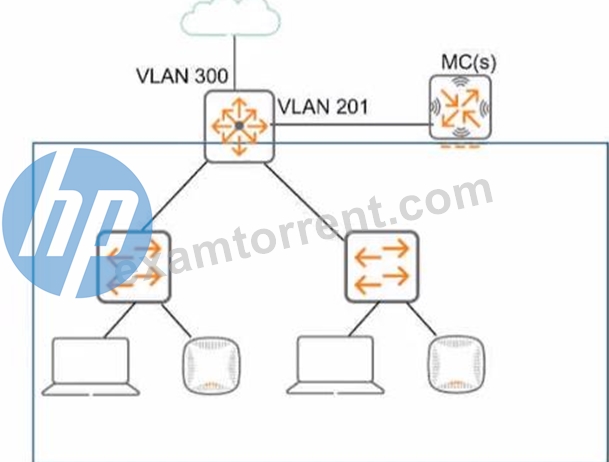
You are deploying a new wireless solution with an Aruba Mobility Master (MM). Aruba Mobility Controllers (MCs). and campus APs (CAPs). The solution will Include a WLAN that uses Tunnel for the forwarding mode and Implements WPA3-Enterprise security What is a guideline for setting up the vlan for wireless devices connected to the WLAN?
- A. Use wireless user roles to assign the devices to a range of new vlan IDs.
- B. Assign the WLAN to a named VLAN which specified 100-150 as the range of IDs.
- C. Assign the WLAN to a single new VLAN which is dedicated to wireless users
- D. Use wireless user roles to assign the devices to different VLANs in the 100-150 range
Answer: D
Explanation:
When setting up VLANs for a wireless solution with an Aruba Mobility Master (MM), Aruba Mobility Controllers (MCs), and campus APs (CAPs), it is recommended to use wireless user roles to assign devices to different VLANs. This allows for greater flexibility and control over network resources and policies applied to different user groups. Wireless user roles can dynamically assign devices to the appropriate VLAN based on a variety of criteria such as user identity, device type, location, and the resources they need to access. This approach aligns with the ArubaOS features that leverage user roles for network access control, as detailed in Aruba's configuration and administration guides.
NEW QUESTION # 110
Refer to the exhibit.
Device A is establishing an HTTPS session with the Arubapedia web sue using Chrome. The Arubapedia web server sends the certificate shown in the exhibit What does the browser do as part of vacating the web server certificate?
- A. It uses the private key in the Arubapedia web site's certificate to check that certificate's signature
- B. It uses the public key in the DigCen SHA2 Secure Server CA certificate to check the certificate's signature.
- C. It uses the private key in the DigiCert SHA2 Secure Server CA to check the certificate's signature.
- D. It uses the public key in the DigCert root CA certificate to check the certificate signature
Answer: B
Explanation:
When a browser, like Chrome, is validating a web server's certificate, it uses the public key in the certificate's signing authority to verify the certificate's digital signature. In the case of the exhibit, the browser would use the public key in the DigiCert SHA2 Secure Server CA certificate to check the signature of the Arubapedia web server's certificate. This process ensures that the certificate was indeed issued by the claimed Certificate Authority (CA) and has not been tampered with.
:
Browser security documentation and SSL/TLS standards that explain the certificate validation process.
Cybersecurity educational resources that cover the principles of public key infrastructure (PKI) and certificate validation.
NEW QUESTION # 111
You are troubleshooting an authentication issue for Aruba switches that enforce 802 IX10 a cluster of Aruba ClearPass Policy Manager (CPPMs) You know that CPPM Is receiving and processing the authentication requests because the Aruba switches are showing Access-Rejects in their statistics However, you cannot find the record tor the Access-Rejects in CPPM Access Tracker What is something you can do to look for the records?
- A. Make sure that CPPM cluster settings are configured to show Access-Rejects
- B. Verify that you are logged in to the CPPM Ul with read-write, not read-only, access
- C. Click Edit in Access viewer and make sure that the correct servers are selected.
- D. Go to the CPPM Event Viewer, because this is where RADIUS Access Rejects are stored.
Answer: A
Explanation:
If Access-Reject records are not showing up in the CPPM Access Tracker, one action you can take is to ensure that the CPPM cluster settings are configured to display Access-Rejects. Cluster-wide settings in CPPM can affect which records are visible in Access Tracker. Ensuring that these settings are correctly configured will allow you to view all relevant authentication records, including Access-Rejects.
:
ClearPass Policy Manager documentation that includes information on cluster settings and Access Tracker configurations.
Troubleshooting guides for ClearPass that provide steps to resolve issues with viewing authentication records.
NEW QUESTION # 112
What is a guideline for deploying Aruba ClearPass Device Insight?
- A. Configure remote mirroring on access layer Aruba switches, using Device Insight Analyzer as the destination IP.
- B. Deploy a Device Insight Collector at every site in the corporate WAN to reduce the impact on WAN links.
- C. For companies with multiple sites, deploy a pair of Device Insight Collectors at the HQ or the central data center.
- D. Make sure that Aruba devices trust the root CA certificate for the ClearPass Device Insight Analyzer's HTTPS certificate.
Answer: C
Explanation:
For deploying Aruba ClearPass Device Insight effectively, especially in environments with multiple sites, it is recommended to deploy a pair of Device Insight Collectors at the headquarters or the central data center.
This deployment strategy helps in centralizing the data collection and analysis, which simplifies management and enhances performance by reducing the data load on the WAN links connecting different sites.
Centralizing the collectors at a major site or data center allows for better scalability and reliability of the network management system. This configuration also aids in achieving a more consistent and comprehensive monitoring and analysis of the devices across the network, ensuring that the security and management policies are uniformly applied. This recommendation is based on best practices for network architecture design, particularly those discussed in Aruba's deployment guides and network management strategies.
NEW QUESTION # 113
Which correctly describes a way to deploy certificates to end-user devices?
- A. ClearPass OnGuard can help to deploy certificates to end-user devices, whether or not they are members of a Windows domain
- B. in a Windows domain, domain group policy objects (GPOs) can automatically install computer, but not user certificates
- C. ClearPass Onboard can help to deploy certificates to end-user devices, whether or not they are members of a Windows domain
- D. ClearPass Device Insight can automatically discover end-user devices and deploy the proper certificates to them
Answer: C
Explanation:
ClearPass Onboard is part of the Aruba ClearPass suite and it provides a mechanism to deploy certificates to end-user devices, regardless of whether or not they are members of a Windows domain. ClearPass Onboard facilitates the configuration and provisioning of network settings and security, including the delivery and installation of certificates to ensure secure network access. This capability enables a bring-your-own-device (BYOD) environment where devices can be securely managed and provided with the necessary certificates for network authentication.
NEW QUESTION # 114
......
Download Free HP HPE6-A78 Real Exam Questions: https://pass4sure.examtorrent.com/HPE6-A78-prep4sure-dumps.html
