

Feb 07, 2024 Updated JN0-213 Dumps Questions For Juniper Exam
Best Value Available Preparation Guide for JN0-213 Exam
Juniper JN0-213 is a certification exam that validates the knowledge and skills required for cloud networking and Juniper Networks' cloud-based solutions. It is designed for networking professionals who want to enhance their expertise in cloud networking and understand the fundamental concepts of cloud computing. JN0-213 exam is also suitable for individuals who are looking to start a career in cloud networking and want to gain a competitive edge in the job market.
Juniper JN0-213 Exam Syllabus Topics:
| Topic | Details |
|---|---|
| Topic 1 |
|
| Topic 2 |
|
| Topic 3 |
|
| Topic 4 |
|
| Topic 5 |
|
| Topic 6 |
|
NEW QUESTION # 13
What are two reasons to create a Kubernetes deployment rather than work with pods directly? (Choose two.)
- A. A deployment is ephemeral and therefore requires less configuration.
- B. A deployment simplifies pod updates and roll-outs.
- C. A deployment contains imperative instructions on how to re-create a pod if a pod dies unexpectedly.
- D. A deployment ensures that the desired number of pods is running at all times.
Answer: B,D
Explanation:
Explanation
A Kubernetes deployment is a resource object in Kubernetes that provides declarative updates to applications. It allows you to describe an application's life cycle, such as which images to use for the app, the number of pods there should be, and the way in which they should be updated1. Two reasons to create a Kubernetes deployment rather than work with pods directly are:
A deployment ensures that the desired number of pods is running at all times1. If a pod crashes, the Deployment will automatically re-create it.
A deployment simplifies pod updates and roll-outs1. It allows you to describe a desired state in its specification and the Deployment controller changes the actual state to the desired state at a controlled rate1. References from Juniper site: Kubernetes Documentation
NEW QUESTION # 14
Click the Exhibit button.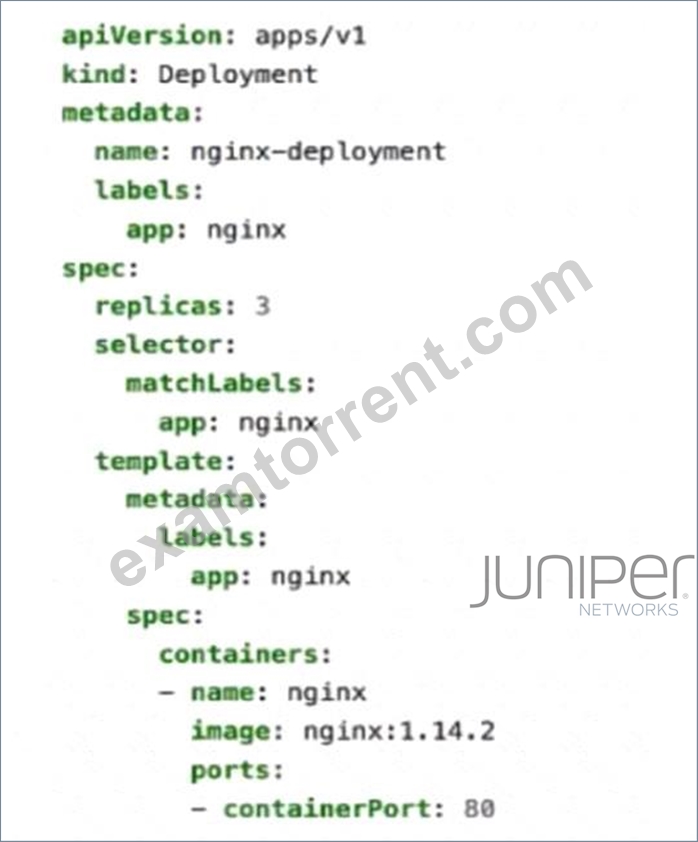
You apply the manifest file shown in the exhibit.
Which two statements are correct in this scenario? (Choose two.)
- A. The created pods are receiving traffic on port 80.
- B. This manifest is used to create a
- C. This manifest is used to create a deployment.
- D. Four pods are created as a result of applying this manifest.
Answer: C,D
Explanation:
Explanation
This manifest is used to create a deployment, which is a Kubernetes resource that manages a set of pods with the same configuration. A deployment can also provide declarative updates, scaling, and rolling back for the pods. The created pods are not receiving traffic on port 80, because the manifest does not specify a service or a selector for the deployment. A service is another Kubernetes resource that defines a logical set of pods and a policy to access them. A selector is a label query that matches the pods that belong to the service. Four pods are created as a result of applying this manifest, because the manifest specifies replicas: 4 in the spec section of the deployment
NEW QUESTION # 15
You must provide tunneling in the overlay that supports multipath capabilities.
Which two protocols provide this function? (Choose two.)
- A. MPLSoGRE
- B. VPN
- C. MPLSoUDP
- D. VXLAN
Answer: C,D
Explanation:
Explanation
MPLSoUDP (Multiprotocol Label Switching over User Datagram Protocol) and VXLAN (Virtual Extensible LAN) are two protocols that provide tunneling in the overlay and support multipath capabilities45.
MPLSoUDP is an encapsulation protocol that allows MPLS packets to be encapsulated in UDP packets. VXLAN is a network virtualization technology that attempts to address the scalability problems associated with large cloud computing deployments
NEW QUESTION # 16
Which two statements are correct about OpenShift monitoring? (Choose two.)
- A. OpenShifis able to configure customized alerts.
- B. OpenShifmonitoring is not compatible with Grafana.
- C. OpenShifhas its own monitoring framework.
- D. OpenShifis not able to configure customized alerts.
Answer: A,C
Explanation:
Explanation
OpenShift includes a preconfigured, preinstalled, and self-updating monitoring stack that provides monitoring for core platform components4. You also have the option to enable monitoring for user-defined projects4. This means OpenShift has its own monitoring framework (B) and is able to configure customized alerts (D).
References from Juniper site: OpenShift Container Platform
NEW QUESTION # 17
Juniper Cloud-Native Contrail Networking (CN2) is able to be integrated with which orchestrator?
- A. Mesosphere
- B. Kubernetes
- C. CloudStack
- D. Marathon
Answer: B
Explanation:
Explanation
Juniper Cloud-Native Contrail Networking (CN2) can be integrated with Kubernetes. CN2 is optimized for Kubernetes-orchestrated environments and can be used to connect, isolate, and secure cloud workloads and services seamlessly across private, public, and hybrid clouds.
NEW QUESTION # 18
You are provisioning workloads on worker nodes in a Kubernetes cluster.
Which CN2 component is responsible for generating associated routes?
- A. vRouter forwarding plane
- B. Contrail kube-manager
- C. Configuration Resource (CR) controllers
- D. vRouter agent microservice
Answer: D
Explanation:
Explanation
The vRouter agent microservice is the CN2 component responsible for generating associated routes. When a pod is scheduled on a node, the vRouter agent on that node programs the necessary routes in the kernel routing table to ensure that traffic destined for that pod is properly routed.
NEW QUESTION # 19
Which two statements about Kubernetes are correct? (Choose two.)
- A. Each container within a pod has a unique IP address.
- B. A ClusterlP service exposes pods to internal and external traffic.
- C. A ClusterlP service exposes pods to internal traffic only
- D. All containers within a pod share the same IP address.
Answer: C,D
Explanation:
Explanation
In Kubernetes, all containers within a pod share the same IP address7. A ClusterIP service exposes pods to internal traffic only87. References from Juniper site: IBM, Kubernetes Documentation
NEW QUESTION # 20
Which term identifies to which network a virtual machine interface is connected?
- A. virtual tunnel endpoint (VTEP)
- B. Virtual Extensible LAN (VXLAN)
- C. machine access control (MAC)
- D. virtual network ID (VNID)
Answer: D
Explanation:
Explanation
The term that identifies to which network a virtual machine interface is connected is the virtual network ID (VNID). The VNID is a unique identifier assigned to each virtual network. It is used to differentiate between different virtual networks and to ensure that each virtual machine interface is connected to the correct network.
NEW QUESTION # 21
What is the name of the Docker container runtime?
- A. cri-o
- B. docker cl
- C. containerd
- D. dockerd
Answer: C
Explanation:
Explanation
The name of the Docker container runtime is containerd, which is a daemon that manages the complete container lifecycle of its host system, from image transfer and storage to container execution and supervision to low-level storage to network attachments and beyond. Dockerd is the Docker daemon that acts as the primary user interface for Docker. Docker cl is not a valid name for any Docker component. Cri-o is another container runtime that implements the Kubernetes Container Runtime Interface (CRI) to enable using OCI (Open Container Initiative) compatible runtimes
NEW QUESTION # 22
Click the Exhibit button.
Referring to the exhibit, which statement is correct?
- A. There are no services.
- B. There are no projects.
- C. There are no virtual machines.
- D. There are no compute nodes.
Answer: C
Explanation:
Explanation
The correct answer is D. There are no virtual machines. Referring to the exhibit, which shows the output of the openstack server list command, we can see that there are no rows in the table, which means that there are no servers (or virtual machines) in the OpenStack environment. The command openstack server list is used to list servers that you can access1. The other statements are incorrect, because the exhibit does not show any information about projects, services, or compute nodes. To list projects, you would use the command openstack project list2. To list services, you would use the command openstack service list2. To list compute nodes, you would use the command openstack compute service list3.
NEW QUESTION # 23
Which statement is correct about overlay or underlay networks or fabrics?
- A. Underlay fabrics enable multitenancy through virtualization.
- B. Overlay networks are Layer 3 networks that must use OSPF for routing purposes.
- C. Underlay fabrics decouple network services from the overlay infrastructure.
- D. Overlay networks are virtual networks.
Answer: D
Explanation:
Explanation
Overlay networks are indeed virtual networks. They are logical constructs that stitch together disparate, dispersed network infrastructure, often referred to as underlay1. Underlay networks refer to the physical network infrastructure, while overlay networks implement network virtualization concepts2. References from Juniper site: Baeldung on Computer Science, PacketFabric, Cisco, HPE Aruba Networking
NEW QUESTION # 24
You are deploying CN2 using Kubernetes as your orchestrator.
In this scenario, which component contains the vRouter agent?
- A. Contrail controller
- B. kube-manager
- C. Ikube-scheduler
- D. worker node
Answer: D
Explanation:
Explanation
In a CN2 deployment using Kubernetes as the orchestrator, the vRouter agent is contained in the worker node.
The vRouter agent is responsible for managing the forwarding plane on each node in a Contrail cluster. It interacts with the kernel to manage the services and interfaces within the virtual networks.
NEW QUESTION # 25
You want to view pods with their IP addresses in OpenShift.
Which command would you use to accomplish this task?
- A. oc get all
- B. oc get pods
- C. oc get pods -o wide
- D. oc get pods -o yaml
Answer: C
Explanation:
Explanation
To view pods with their IP addresses in OpenShift, you would use the command oc get pods -o wide23. This command provides additional information such as the IP address and the node where the pod is located23.
References from Juniper site: OpenShift Documentation, Stack Overflow
NEW QUESTION # 26
Which two statements are true regarding isolated namespaces in Juniper Cloud-Native Contrail Networking (CN2)? (Choose two.)
- A. Pods in isolated namespaces can only communicate with pods in the same namespace.
- B. Pods in isolated namespaces can only reach services in the same namespace.
- C. Pods in isolated namespaces can communicate with pods in non-isolated namespaces.
- D. Pods in isolated namespaces can reach services in non-isolated namespaces.
Answer: A,B
Explanation:
Explanation
In Juniper Cloud-Native Contrail Networking (CN2), isolated namespaces are used to isolate a pod from other pods without explicitly configuring a network policy3. Pods in an isolated namespace can only communicate with pods in the same namespace3. They cannot reach pods or services in other isolated or non-isolated namespaces3.
NEW QUESTION # 27
Which virtualization method requires less duplication of hardware resources?
- A. full virtualization
- B. OS-level virtualization
- C. paravirtualization
- D. hardware-assisted virtualization
Answer: B
Explanation:
Explanation
OS-level virtualization requires less duplication of hardware resources. This method allows multiple instances of an operating system or multiple different operating systems to run on a single physical server, sharing the same hardware resources. This results in more efficient use of hardware resources compared to other virtualization methods such as full virtualization or paravirtualization
NEW QUESTION # 28
......
Full JN0-213 Practice Test and 67 Unique Questions, Get it Now!: https://pass4sure.examtorrent.com/JN0-213-prep4sure-dumps.html
