

[Nov 11, 2024] Get to the Top with JN0-363 Practice Exam Questions
Use Real JN0-363 Dumps Free Sample Questions and Practice Test Engine
To take the Juniper JN0-363 exam, candidates must have a solid understanding of networking concepts and protocols, as well as experience configuring and troubleshooting Juniper Networks routers and switches. Candidates should also have a good understanding of service provider networking and the challenges associated with managing large-scale networks. The JN0-363 exam is designed to validate the skills and knowledge required to work in a service provider environment and is a valuable certification for network professionals who want to advance their career.
The JN0-363 certification exam is ideal for network professionals who work in service provider environments, such as Internet service providers (ISPs), telecom companies, and cloud service providers. Service Provider Routing and Switching, Specialist (JNCIS-SP) certification exam is a valuable credential for professionals who want to advance their careers in the networking industry and demonstrate their expertise in service provider routing and switching. The JN0-363 certification exam is recognized globally and is a highly respected credential in the networking industry.
NEW QUESTION # 35
Click the Exhibit button. You have two routers connected over a Gigabit Ethernet link as shown in the exhibit It is required that an IS-IS adjacency be established without the need for a designated intermediate system (DIS)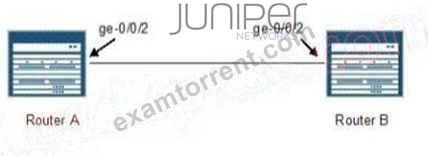
Which configuration statement entered on both routers will achieve this goal?
- A. set interface ge-0/0/2 unit 0 family iso no-dis
- B. set interface ge-0/0/2 unit 0 family iso point-to-point
- C. set protocols isis interface ge-0/0/2.0 point-to-point
- D. set protocols isis interface ge-0/0/2.0 no-dis
Answer: C
NEW QUESTION # 36
Click the Exhibit button. You have two routers connected over a Gigabit Ethernet link as shown in the exhibit It is required that an IS-IS adjacency be established without the need for a designated intermediate system (DIS)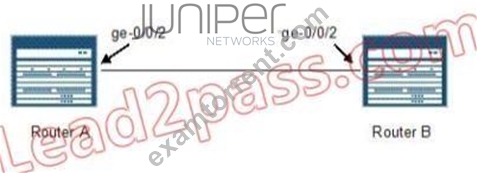
Which configuration statement entered on both routers will achieve this goal?
- A. set interface ge-0/0/2 unit 0 family iso no-dis
- B. set interface ge-0/0/2 unit 0 family iso point-to-point
- C. set protocols isis interface ge-0/0/2.0 point-to-point
- D. set protocols isis interface ge-0/0/2.0 no-dis
Answer: C
NEW QUESTION # 37
Exhibit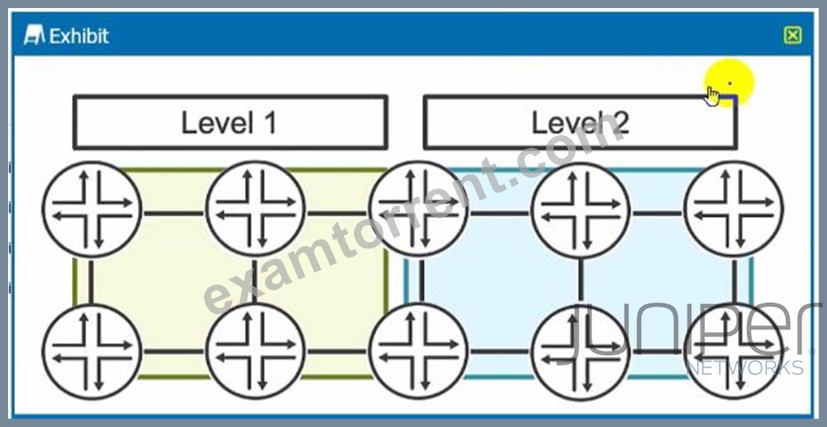
Referring to the exhibit, which two statements are correct? (Choose two.)
- A. Prefixes in Level 2 will be redistributed to Level 1.
- B. Prefixes in Level 1 will not be redistributed to Level 2.
- C. Prefixes in Level 1 will be redistributed to Level 2.
- D. Prefixes in Level 2 will be not redistributed to Level 1.
Answer: C,D
Explanation:
By default, IS-IS protocol leaks routing information from a Level 1 area to a Level 2 area. However, to leak routing information from a Level 2 area to a Level 1 area, an export policy must be explicitly configured.
NEW QUESTION # 38
Which two statements ate correct about the BGP next-hop attribute value? (Choose two.)
- A. By default, the next-hop value is changed across EBGP links.
- B. By default, the next-hop value is not changed across EBGP links.
- C. By default, the next-hop value is not changed across IBGP links.
- D. By default, the next-hop value is changed across IBGP links.
Answer: A,C
Explanation:
By default, the router that originally sourced the route into BGP places its peer address into the attribute field.
The next-hop value is then typically changed when the route is transmitted across external gGP (EBGP) links.
Internal BGP (IBGP) peers do not alter the next-hop value between themselves.
B). By default, the next-hop value is changed when a route is passed from an EBGP peer to another EBGP peer.C. By default, the next-hop value is retained when a route is advertised across IBGP links.References:
BGP Next Hop Attribute, Juniper TechLibrary
Understanding BGP Next-Hop Selection, Juniper TechLibrary
NEW QUESTION # 39
Referring to the exhibit, where should next-hop-self-policy be applied to alter the next-hop value?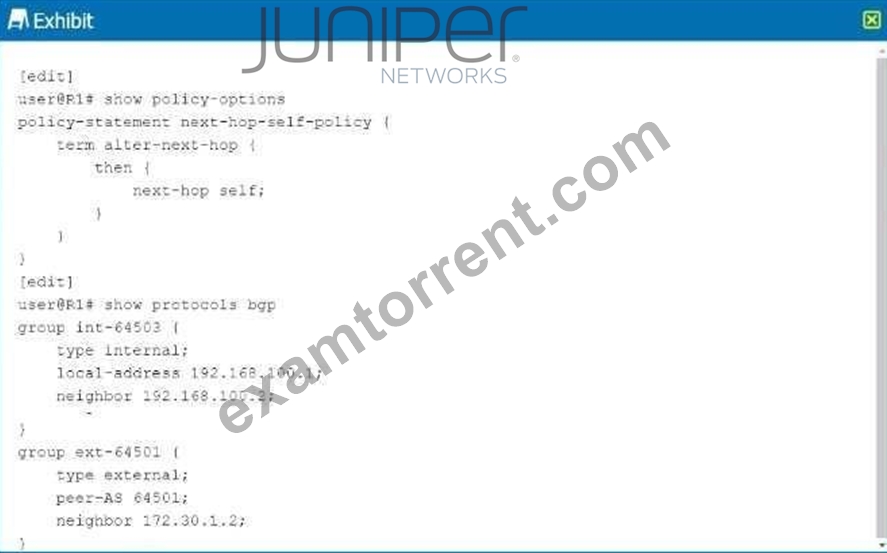
- A. The policy is applied as an export policy for the group int-64503.
- B. The policy is applied as an export policy for the group ext-64501.
- C. The policy is applied as an Import policy for the group ext-64501.
- D. The policy is applied as an import policy for the group int- 64 503.
Answer: C
NEW QUESTION # 40
Exhibit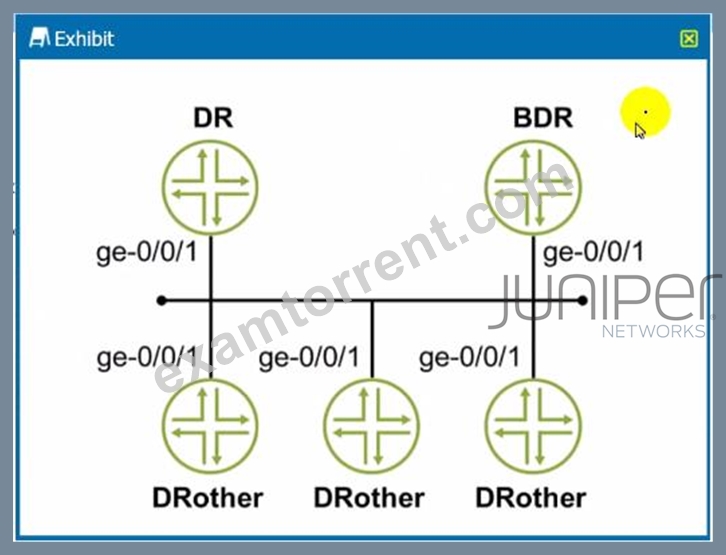
You are asked to configure the OSPF environment to prevent the DRother routers from participating in DR/BDR election.
Referring to the exhibit, which command will accomplish this task?
- A. set protocols ospf area 0.0.0.0 interface ge-0/0/1 interface-type nbma
- B. set protocols ospf area 0.0.0.0 interface ge-0/0/l priority 255
- C. set protocols ospf area 0.0.0.0 interface ge-0/0/1 interface-type p2p
- D. set protocols ospf area 0.0.0.0 interface ge-0/0/1 priority 0
Answer: B
NEW QUESTION # 41
Click the Exhibit.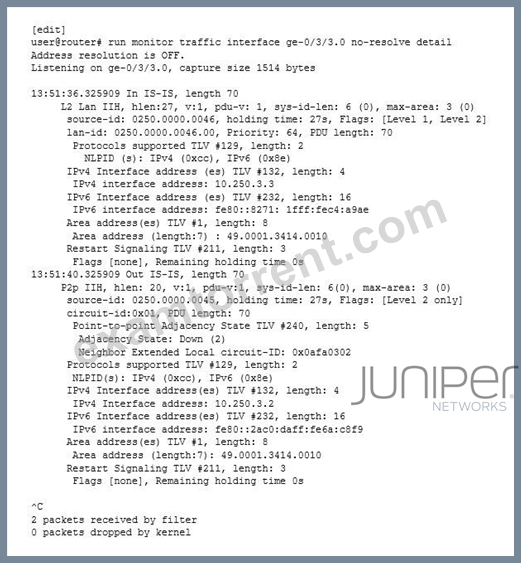
You have just configured IS-IS, but the adjacency is not coming up.
Referring to the exhibit, what is the cause?
- A. The family iso parameters is missing on the interfaces.
- B. One router is configured for Level 2 only.
- C. Only one side is configured using the point-to-point parameter.
- D. The routers must be in different areas.
Answer: C
NEW QUESTION # 42
Click the Exhibit button. The policy shown in the exhibit has been configured and installed on your router.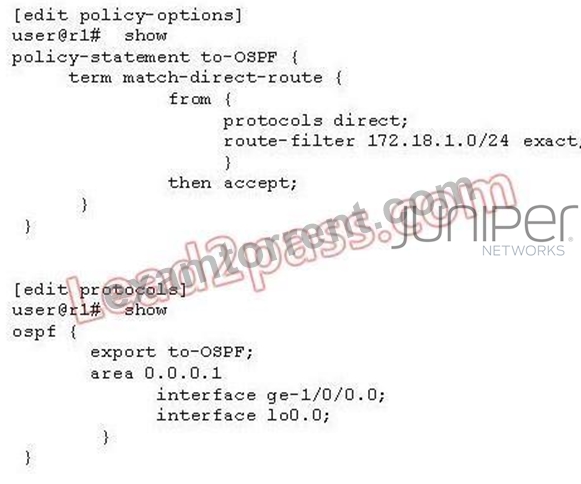
What is the result of applying this policy?
- A. The 172.18.1.0/24 network will be redistributed into OSPF as an internal route.
- B. The 172.18.1.0/32 network will be redistributed into OSPF as an external route.
- C. The 172.18.1.0/24 network will be redistributed into OSPF as an external route.
- D. The 172.18.1.0/32 network will be redistributed into OSPF as an internal route.
Answer: C
NEW QUESTION # 43
The exhibit shows a topology with 1 Gbps interfaces between routers, and four RSVP LSPs operating with the respective bandwidth reservations.
Which path will be selected for a new LSP from R4 to R6 with a bandwidth reservation of 400 Mbps?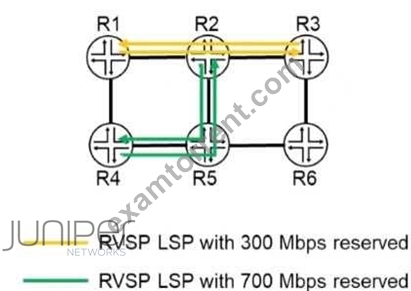
- A. R4 -> R1 -> R2 -> R5 -> R6
- B. R4 -> R5 -> R2 -> R3 -> R6
- C. R4 -> R5 -> R6
- D. R4 -> R1 -> R2 -> R3 -> R6
Answer: A
NEW QUESTION # 44
Click the Exhibit button. You have two routers connected over a Gigabit Ethernet link as shown in the exhibit It is required that an IS-IS adjacency be established without the need for a designated intermediate system (DIS)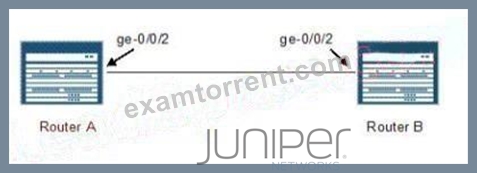
Which configuration statement entered on both routers will achieve this goal?
- A. set interface ge-0/0/2 unit 0 family iso no-dis
- B. set interface ge-0/0/2 unit 0 family iso point-to-point
- C. set protocols isis interface ge-0/0/2.0 point-to-point
- D. set protocols isis interface ge-0/0/2.0 no-dis
Answer: C
NEW QUESTION # 45
Exhibit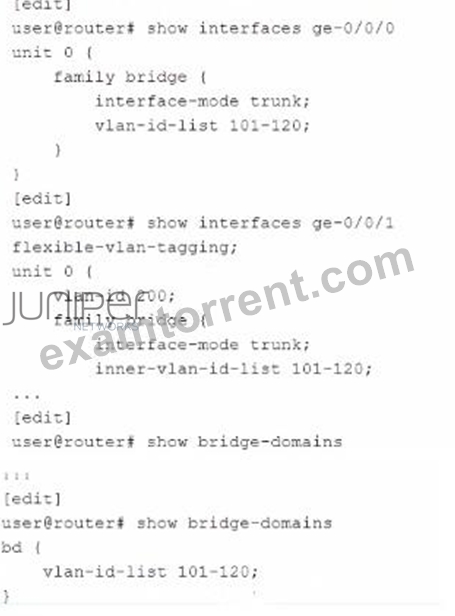
Referring to the exhibit, which two statements are correct? (Choose two.)
- A. Traffic ingressing ge-0/0/0 that is tagged will VLAN 100 will be dropped.
- B. Traffic ingressing ge-0/0/0 that is tagged with VLAN 101 will egress ge-0/0/1 unchanged.
- C. Traffic ingressing ge0/0/0 that Is tagged with VLAN 200 will egress ge-0/0/1 with an outer VLAN tag of 200.
- D. Traffic ingressing ge-0/0/0 that is tagged with VLAN 101 will egress ge-0/0M with an outer VLAN tag of 200.
Answer: A,B
NEW QUESTION # 46
Which two statements ate correct about the actions taken as the packet traverses the service provider MPLS network from Site 1 to Site 2 as shown in the exhibit?
(Choose two.)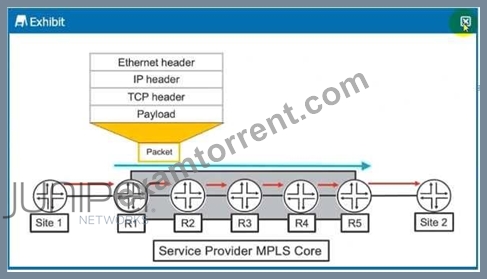
- A. R1 will perform a lookup using the mpls.0 table.
- B. R2 will perform a lookup using the inet.3 table.
- C. R1 will perform a lookup using the lnet.3 table.
- D. R2 will perform a lookup using the mpls.0 table.
Answer: D
NEW QUESTION # 47
What are three types of MPLS routers? (Choose three.)
- A. peering routers
- B. egress routers
- C. aggregation routers
- D. transit routers
- E. ingress routers
Answer: B,D,E
Explanation:
https://www.juniper.net/documentation/us/en/software/junos/mpls/topics/topic-map/lsp-routers.html
NEW QUESTION # 48
Exhibit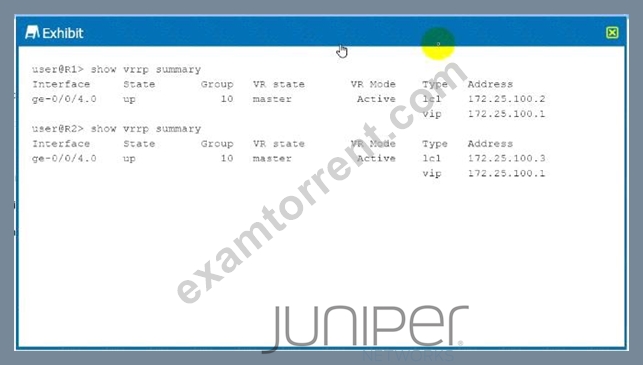
Referring to the exhibit, which statement is true about VRRP?
- A. The routers should use different virtual IP addresses for VRRP to function correctly.
- B. VRRP communication between the two devices is not functioning correctly.
- C. VRRP Is functioning normally in active/active mode.
- D. Both routers are in the same state because they have the same VRRP priority.
Answer: C
Explanation:
The exhibit shows theshow vrrp summaryoutput from two routers, with both routers listing the state of their VRRP group asmaster. VRRP allows for multiple routers to share a virtual IP address and a virtual MAC address, but usually, only one router is the master at any given time while others are in backup state. However, in some configurations, VRRP can operate in an active/active mode where multiple routers handle traffic simultaneously for load sharing. Since both routers show the state asmasterand there is no evidence of misconfiguration in the virtual IP addresses or priority, it indicates that VRRP is likely functioning in an active/active setup.
References:
Juniper documentation on VRRP: Junos OS VRRP Overview
NEW QUESTION # 49
Click the Exhibit. You are receiving the same route prefix from four EBGP neighbors.
Based on the information provided in the exhibit, which route will be selected?
- A. Route 2
- B. Route 4
- C. Route 3
- D. Route 1
Answer: C
NEW QUESTION # 50
Because of recent network failures, additional circuits have been purchased. In addition, Fast reroute has been configured on critical MPLS LSPs.
When the next failure occurs, which two time intervals will affect fast reroute? (Choose two.)
- A. The amount of time required to recalculate the best detour
- B. The amount of time required to reroute the traffic onto the detour
- C. The amount of time it takes to ping the gateway on the detour link
- D. The amount of time to detect a link or node failure
Answer: B,D
NEW QUESTION # 51
Click the Exhibit.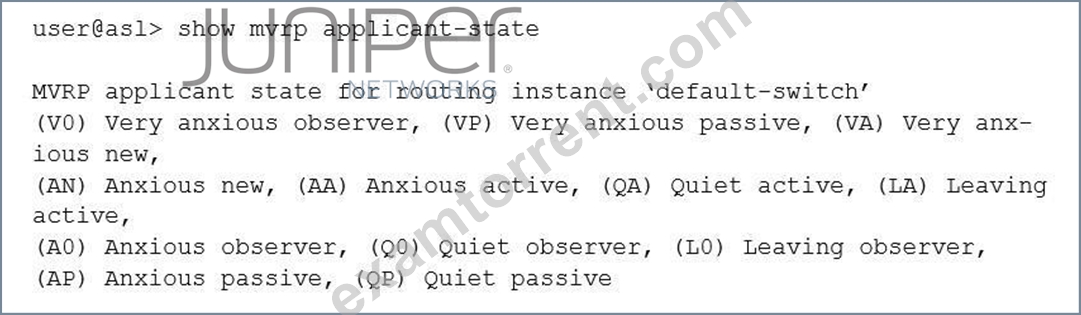
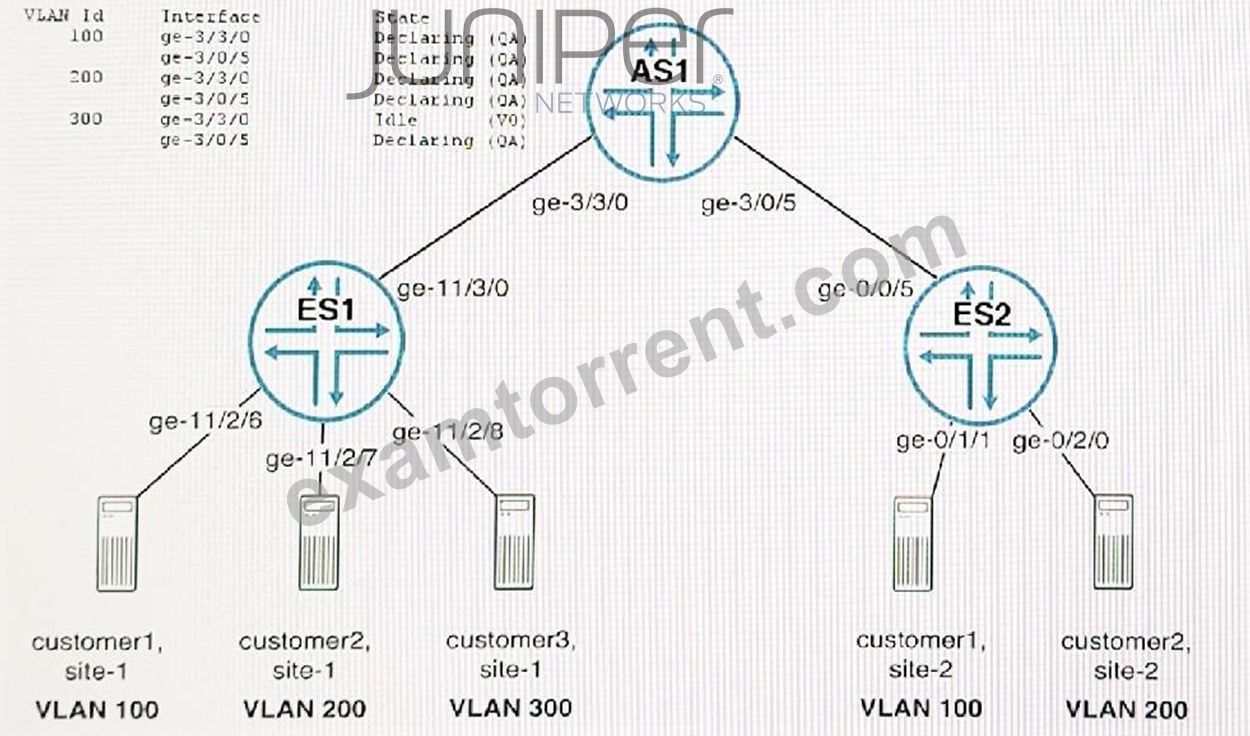
Referring to the exhibit, which statement is correct about MVRP?
- A. AS1's VLAN ID list is missing an entry for VLAN 300.
- B. ES1 is not advertising VLAN 300 to AS1.
- C. AS1 is not allowing ES2 access to VLAN 300.
- D. ES2 is not interested in VLAN 300.
Answer: D
NEW QUESTION # 52
Exhibit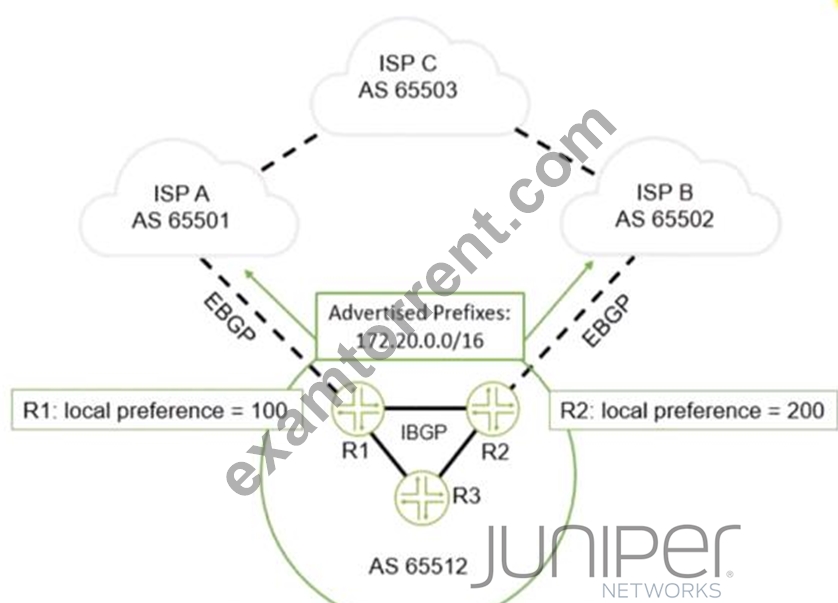
You are advertising a summary route that represents your local network (172.20.0.0716) to both ISP A and ISPB. You want to influence all traffic sent to you from ISP C to go through R2.
How would you accomplish this task?
- A. On R1, change the local preference value to 250.
- B. On R2, change the local preference value to 50.
- C. On R1, prepend your AS number three times on the 172.20.0.0/16 route when advertising It to ISP 1.
- D. On R2. prepend your AS number three times on the 172.20.0.0/16 route when advertising it to ISP 2.
Answer: A
NEW QUESTION # 53
Which two statements describe operations performed by the encapsulating tunnel endpoint in an IP-IP tunnel? (Choose two.)
- A. It adds an outer IP header with the destination address of the remote tunnel endpoint
- B. It decrements the time-to-live (TTL) counter by one in the inner IP header
- C. It creates and adds a new inner IP header with the remote destination device's IP address
- D. It modifies the source and destination addresses in the inner IP header
Answer: A,B
NEW QUESTION # 54
Which two statements are correct about segment routing? (Choose two.)
- A. Segment routing adjacencies require very little resources to maintain.
- B. Label assignments can be advertised through OSPF updates.
- C. There are no segment routing adjacencies to maintain.
- D. Label assignments can be advertised through LDP updates.
Answer: A,B
Explanation:
Segment routing is a source routing paradigm that allows a source router to define the path that a packet will take through the network by assigning an ordered list of segments-identifiers that specify a forwarding path for the packet through the network. Segment Routing can be implemented over an MPLS architecture or with IPv6 (SRv6).
A). Segment routing does not require a full mesh of adjacencies or state per transit path in the network, which is often the case with conventional MPLS signaling protocols like RSVP-TE. It leverages the existing IGP topology for forwarding without the need to maintain a state for each LSP (Label Switched Path), hence requiring very little resources to maintain.
B). In segment routing, labels (or segments) are distributed via IGP routing protocols like OSPF or IS-IS with extensions to carry segment routing information. These protocols are enhanced with Segment Routing extensions to distribute labels. For example, OSPFv2 is extended with Segment Routing extensions defined in RFC 8665.
C). This statement is not entirely correct. While it is true that segment routing does not require the maintenance of a state for each path (LSP), the concept of "segment routing adjacencies" is a mischaracterization. Segment routing leverages the existing adjacencies formed by the underlying IGP.
D). Label assignments in segment routing are not advertised through LDP (Label Distribution Protocol) updates. Segment routing does away with LDP and instead uses IGP extensions to distribute labels.
References:
Juniper Networks documentation on Segment Routing: Segment Routing Overview Juniper Networks technical documentation providing guidance on configuring OSPF with Segment Routing extensions.
IETF RFC 8665: OSPF Extension for Segment Routing.
NEW QUESTION # 55
......
The JNCIS-SP Certification is a valuable credential for networking professionals who work in service provider environments. It demonstrates a high level of expertise in Junos software and service provider routing and switching technologies. Service Provider Routing and Switching, Specialist (JNCIS-SP) certification can lead to career advancement opportunities, such as senior network engineer or network architect roles.
Pass Juniper JN0-363 exam - questions - convert Tets Engine to PDF: https://pass4sure.examtorrent.com/JN0-363-prep4sure-dumps.html
