

Attested 1z0-931-23 Dumps PDF Resource [2024]
Latest 1z0-931-23 Actual Free Exam Questions Updated 183 Questions
Oracle 1z0-931-23 Exam Syllabus Topics:
| Topic | Details |
|---|---|
| Topic 1 |
|
| Topic 2 |
|
| Topic 3 |
|
| Topic 4 |
|
| Topic 5 |
|
| Topic 6 |
|
| Topic 7 |
|
| Topic 8 |
|
NEW QUESTION # 10
Which two statements are true about Recovery Time Objective (RTO) and Recovery Point Objective (RPO) for Autonomous Data Guard?
- A. RTO and RPO are 0 minutes for manual failovers
- B. RTO is 2 minutes for an automatic failover
- C. RTO and RPO are adjustable through the OCI console
- D. RPO is adjustable, but RTO I always 5 minutes
- E. RPO is 0 minutes for an automatic failover
Answer: B,E
NEW QUESTION # 11
Which statement is true when you provision an Autonomous Database using the cloning method?
- A. After an Autonomous database is created using a clone, the network access option can be changed.
- B. When cloning an Autonomous Database, Oracle Machine Learning workspaces, projects, and notebooks of the source database are cloned to the new database.
- C. A clone database source can be a running database instance.
- D. A clone database source can be from a point-in-time backup that is less than 2 hours old.
Answer: C
NEW QUESTION # 12
Which three are use cases for Graph Studio? (Choose three.)
- A. Facial recognition
- B. Pattern matching
- C. Churn analysis
- D. 3-D modelling
- E. Clustering
Answer: B,D,E
NEW QUESTION # 13
Which two statements are FALSE about creating a metadata-only clone with a private endpoint network access option?
- A. All underlying data for OML notebooks is cloned.
- B. All resource management rules are cloned.
- C. Clone can be in a different region.
- D. All OML notebooks are cloned.
- E. Current settings for ACLs are cloned.
Answer: A,C
Explanation:
https://docs.oracle.com/en/cloud/paas/autonomous-database/adbsa/autonomous-clone-notes.html#GUID-F943E7FF-8DEB-47F4-84C0-FFA5BAF9D5A9
NEW QUESTION # 14
What are the two supported infrastructure options for deploying an Autonomous Database?
- A. Bare-metal on Oracle Cloud Infrastructure
- B. Dedicated Exadata Infrastructure
- C. Any Oracle Engineered System
- D. VM on Oracle Cloud Infrastructure
- E. Shared Exadata Infrastructure
Answer: B,E
NEW QUESTION # 15
In Graph Studio which you can use to create a graph?
- A. Graph created by a special tool downloaded from Oracle.com
- B. Tables in an Autonomous Database instance
- C. NoSQL configuration
- D. A graph license key
- E. Graph analytics algorithms
Answer: B
NEW QUESTION # 16
Autonomous Database's auto scaling feature allows your database to use up to three times the current base number of CPU cores at any time. As demand increases, auto scaling automatically increases the number of cores in use. Likewise, as demand drops, auto scaling automatically decreases the number of cores in use.
Which statement is FALSE regarding the auto scaling feature?
- A. Auto scaling is enabled by default and can be enabled or disabled at any time.
- B. For databases on dedicated Exadata infrastructure, the maximum number of cores is limited by the number of free cores that aren't being used by other auto scaling databases to meet high-load demands.
- C. For databases on dedicated Exadata infrastructure, the maximum number of cores available to a database depends on the total number of cores available in the Exadata infrastructure instance.
- D. The base number of OCPU cores allocated to a database is not guaranteed.
Answer: D
NEW QUESTION # 17
Oracle Data Safe is a unified control center for your Oracle databases which helps you understand the sensitivity of your data, evaluate risks to data, mask sensitive data, implement and monitor security controls, assess user security, monitor user activity, and address data security compliance requirements.
Which statement is FALSE?
- A. Oracle Data Safe helps you find sensitive data in your database by inspecting the actual data in your database and its data dictionary.
- B. Oracle Data Safe helps you assess the security of your cloud database configurations by analyzing database configurations.
- C. Oracle Data Safe evaluates user types, how users are authenticated, and the password policies assigned to each user.
- D. Oracle Data Safe only supports Autonomous Databases.
Answer: D
Explanation:
https://www.oracle.com/database/technologies/security/data-safe.html
https://www.oracle.com/a/tech/docs/dbsec/data-safe/faq-security-data-safe.pdf Data Safe works with the following Oracle Databases Oracle on-Premises Databases Oracle Cloud Databases
- Autonomous Database on Shared Exadata Infrastructure
- Autonomous Database on Dedicated Exadata Infrastructure
- Exadata DB systems
- Database Cloud Service on Virtual Machine
- Database Cloud Service on Bare Metal
- Oracle Database on Compute
NEW QUESTION # 18
Which statement is NOT correct when using Automatic Indexing on Autonomous Data Warehouse?
- A. Process includes identify candidates, create invisible auto indexes , verify with implement if performance improved and delete unused.
- B. You can control behavior at the statement level using the use_aoto_indexes or NO_USE_AUTO_INDEXES hints.
- C. You can use the dbms_auto_index package to report on the automatic task and to set your preferences.
- D. The indexing feature is implemented as an automatic task that runs at a fixed interval.
- E. It is enabled by default.
Answer: E
Explanation:
https://docs.oracle.com/en/cloud/paas/autonomous-database/adbsa/autonomous-auto-index.html#GUID-D51A4F85-3AE5-4B7D-9B27-32CEDE8DBD79 - Auto Indexing is disabled by default in Autonomous Database
NEW QUESTION # 19
Which two statements are correct about Autonomous Data Warehouse on Shared Exadata Infrastructure?
- A. Compression is enabled by default. Autonomous Data Warehouse uses Hybrid Columnar Compression for all tables by default.
- B. Parallelism is not enabled by default.
- C. You have direct access to the database node.
- D. Oracle Database Result Cache is enabled by default for all SQL statements.
Answer: A,D
Explanation:
https://docs.oracle.com/en/cloud/paas/autonomous-database/adbsa/appendix-autonomous-database-data-warehouse-workload.html#GUID-604A08F8-8021-43CE-AA95-823045E14BD8
NEW QUESTION # 20
In the Autonomous Database (ADB) Dedicated service, what does the fleet administrator use to control OCPU utilization?
- A. Oracle Machine Learning notebook
- B. Compartment quotas
- C. SQL Developer Web Console
- D. Resource Manager settings
Answer: B
Explanation:
https://docs.oracle.com/en-us/iaas/Content/Database/Concepts/adboverview.htm
NEW QUESTION # 21
Which Autonomous Database Cloud service ignores hints in SQL Statements by default?
- A. Neither service ignores hints by default
- B. Autonomous Data Warehouse
- C. Both services ignore hints by default
- D. Autonomous Transaction Processing
Answer: B
Explanation: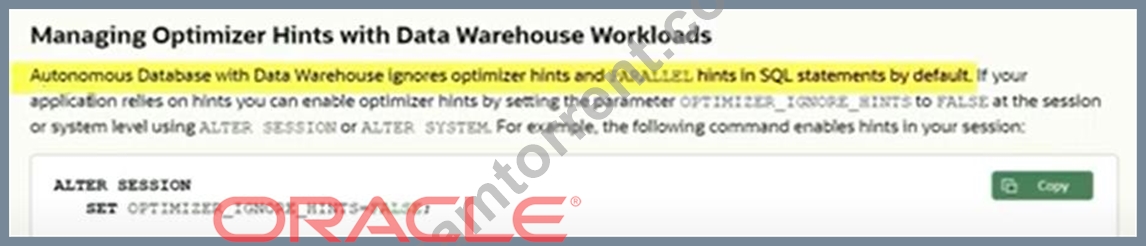
NEW QUESTION # 22
When enabling auto-scaling, which three options do not change?
- A. Amount of storage
- B. parallelism settings
- C. Number of OCPUs displayed in the console.
- D. Level of concurrency
- E. I/O resources
Answer: A,B,D
Explanation:
https://docs.oracle.com/en/cloud/paas/autonomous-database/adbsa/autonomous-auto-scale.html#GUID-27FAB1C1-B09F-4A7A-9FB9-5CB8110F7141
NEW QUESTION # 23
Which Database Actions tool is used to get information about the entries on your Oracle Autonomous Database and to see the effect that changing an object has on other objects.
- A. Catalog
- B. Data Load
- C. JSON
- D. Data Insight
Answer: A
Explanation:
Data Catalog
Data Catalog: it helps to get information about the entities in your Oracle Autonomous Database and to see the effect that changing an object has on other objects. Data lineage and impact analysis is key for a Data driven company.
https://blogs.oracle.com/pcoe/post/autonomous-database-tools-for-database-actions#:~:text=Data%20Catalog%3A%20it%20helps%20to,for%20a%20Data%20driven%20company.
NEW QUESTION # 24
What REST verb is used to create an Autonomous Database service using REST APIs?
- A. A "PUT" REST call
- B. A "POST" REST call
- C. A "GET" REST call
- D. An "INSERT" REST call
Answer: B
Explanation:
https://docs.oracle.com/en/cloud/paas/integration-cloud/rest-api/SendRequests.html To create an Autonomous Database service using REST APIs, you need to use a POST method with the appropriate request body. See Create Autonomous Database for more details.
NEW QUESTION # 25
Who, and in which order, provisions dedicated Exadata Infrastructure resources?
- A. The database administrator provisions the Autonomous Container DB and the Autonomous DB Then, the feet administrator provisions the Autonomous Exadata Infrastructure
- B. The database administrator provisions the Autonomous Exadata Infrastructure. Then, the fleet administrator provisions the Autonomous Container DB and then the Autonomous DB
- C. The fleet administrator provisions the Autonomous Exadata Infrastructure. Then, the database administrator provisions the Autonomous Container DB and then the Autonomous DB
- D. The fleet administrator provisions the Autonomous Exadata Infrastructure and then the Autonomous Container DB. Then, the database administrator provisions the Autonomous DB
Answer: D
NEW QUESTION # 26
Where are customer-managed encryption keys stored for Autonomous Database on Dedicated Infrastructure?
- A. inside the Autonomous Database wallet
- B. on the Exadata Infrastructure where Autonomous Database Dedicated is hosted
- C. In a separate key vault external to the Exadata Infrastructure
- D. inside the backups of the container database
Answer: C
NEW QUESTION # 27
A new Python developer has joined your team and needs to access the Autonomous Database (ADB) data.
How does the developer connect to and interact with ADB from Python?
- A. You can't use Python with ADB.
- B. SQL Developer
- C. The Oracle Client and the cx_Oracle interface for Python
- D. JAVA JDK
Answer: C
Explanation:
https://docs.oracle.com/en/cloud/paas/autonomous-database/adbsa/connecting-nodejs.html#GUID-AB1E323A-65B9-47C4-840B-EC3453F3AD53
https://developer.oracle.com/databases/database-for-python-developers-1.html
NEW QUESTION # 28
......
1z0-931-23 Certification Overview Latest 1z0-931-23 PDF Dumps: https://pass4sure.examtorrent.com/1z0-931-23-prep4sure-dumps.html
